
BUILDIT practical construction wisdom
Field-tested sayings, warnings and lessons that experienced construction people pass down because somebody usually learned them the expensive way.
Loading sayings…
ON SITE
IN THE OFFICE
IN THE BOARD ROOM

A bird in the hand is worth two in the bush
Bank the defensible outcome before gambling it for a prettier one.
ON SITE
Secure the access, possession, approved method or workable sequence you actually have before trading it for a promise that depends on three other crews lining up perfectly.
IN THE OFFICE
A certain payment, signed variation or documented settlement can be worth more than a bigger theoretical recovery with weak evidence, long delay or doubtful collectability.
IN THE BOARD ROOM
Executives price certainty. Do not sacrifice a bankable outcome merely to chase an optimistic upside that consumes cash, time and relationship capital.

A poor tradesman blames his tools
Fix your method before blaming the system around you.
ON SITE
Bad drawings, awkward access and imperfect plant are real constraints, but first ask whether the work was planned, checked and coordinated properly. Good operators distinguish a genuine constraint from an excuse.
IN THE OFFICE
Software, templates and slow reviewers get blamed for plenty of weak administration. Before escalating the tool, check the input, sequence, ownership and whether your submission was actually decision-ready.
IN THE BOARD ROOM
At leadership level, recurring failure blamed on systems usually signals an operating-model problem. Improve capability and process before buying another platform and expecting behaviour to change.

A rising tide raises all boats
Improve the system and good people get better together.
ON SITE
Clean access, stable sequencing, reliable logistics and clear interfaces lift every crew’s productivity. Do not optimise one workfront by quietly making three others worse.
IN THE OFFICE
Shared standards, useful templates, good records and clear review rhythms reduce rework across the whole commercial team instead of creating one heroic high performer.
IN THE BOARD ROOM
Enterprise gains come from repeatable capability, not isolated stars. Invest in systems, leaders and incentives that raise the baseline across projects.

A stitch in time saves nine
The cheapest problem is the one you close while it is still small.
ON SITE
A minor defect, access clash or unclosed hold point rarely gets cheaper after the next trade covers it. Fix the early signal before it turns into demolition, delay and argument.
IN THE OFFICE
Send the notice, correct the forecast, clarify the scope and close the record while the facts are fresh. Small admin gaps compound quickly once money and positions harden.
IN THE BOARD ROOM
Early intervention preserves options. Leaders should reward controlled early warnings rather than create a culture where problems are hidden until they are board-sized.

A teaspoon of cement
Sometimes the useful advice is simply: toughen up, but know what deserves escalation.
ON SITE
Construction is noisy, imperfect and occasionally uncomfortable. Do not turn every inconvenience into a crisis—but never use toughness as an excuse to ignore safety, fatigue, bullying or a real technical risk.
IN THE OFFICE
A robust commercial professional can take challenge, rework and blunt feedback without becoming defensive. Separate bruised ego from material risk and escalate the latter cleanly.
IN THE BOARD ROOM
Resilience matters, but leaders who use ‘harden up’ to suppress legitimate concerns eventually lose information. Build a culture that can handle pressure and still hear bad news.

A wolf in sheep’s clothing
Judge behaviour, incentives and evidence—not the friendly wrapper.
ON SITE
A subcontractor, supplier or stakeholder can sound cooperative while quietly protecting a position that shifts risk onto you. Verify commitments against what is actually being done on site.
IN THE OFFICE
Warm emails and agreeable meetings are not evidence. Read the exclusions, qualifications, programme assumptions and change positions behind the relationship.
IN THE BOARD ROOM
In executive rooms, alignment language can hide competing incentives. Keep relationships civil while testing who benefits, who carries downside and what is actually committed.

All hands on deck
When the project is genuinely in trouble, titles matter less than coordinated action.
ON SITE
A critical pour, recovery shift or safety event may need everyone focused on the same immediate outcome. Define the priority, roles and handoffs so extra bodies do not create extra confusion.
IN THE OFFICE
During a commercial crunch, temporarily concentrate effort on the few actions that protect cash, entitlement, forecast or an irreversible date. Stop low-value work rather than pretending everything remains priority one.
IN THE BOARD ROOM
Leaders should declare the emergency, narrow the objectives and then stand the organisation back down. Permanent crisis mode is not mobilisation; it is failed management.

Always get it in writing
If it matters later, give future-you a reliable record now.
ON SITE
Verbal directions and corridor agreements disappear when programme pressure rises. Confirm the scope, instruction, access commitment or changed sequence in a proportionate record while everyone still agrees what happened.
IN THE OFFICE
Material conversations should close with position, action, owner and date. A concise contemporaneous record usually beats a perfect reconstruction six months later.
IN THE BOARD ROOM
Boards and dispute teams inherit documents, not memories. Encourage disciplined records without turning every conversation into performative legal correspondence.

Always play a straight bat
Use the grey intelligently; never manufacture the facts.
ON SITE
Be firm about actual conditions, quantities, delay and responsibility, but do not massage site facts to improve a commercial story. Bad evidence contaminates good entitlement.
IN THE OFFICE
State what you know, what you assume and where the weakness sits. A defensible position can be aggressive commercially without becoming dishonest or misleading.
IN THE BOARD ROOM
Reputation compounds across clients and projects. Executives can recover from losing an argument; recovering from a credibility failure is much harder.

Backing both horses
Keep options open deliberately, but do not pretend incompatible positions can both win forever.
ON SITE
Parallel workfaces, alternate methods or contingency suppliers can be sensible until a decision point arrives. Know when optionality becomes duplication, confusion or unsafe overlap.
IN THE OFFICE
You may preserve alternative contractual or settlement paths while facts develop, but label them as options. Do not issue contradictory positions to different audiences and hope nobody compares notes.
IN THE BOARD ROOM
At board level, hedging is useful until it obscures strategy. Set the trigger for choosing a path and accept that preserving every option has a cost.

Bent over a barrel
Never discover your negotiating leverage only after you have run out of alternatives.
ON SITE
If one crane, supplier, permit or access route controls the next milestone, your bargaining position is already weak. Build contingencies before the dependency becomes urgent.
IN THE OFFICE
Single-source procurement, late approvals and expiring rights create commercial captivity. Protect BATNAs, notice dates, alternate suppliers and decision time.
IN THE BOARD ROOM
Boards should notice structural dependencies early. Once the business has no credible alternative, negotiation becomes damage control rather than strategy.
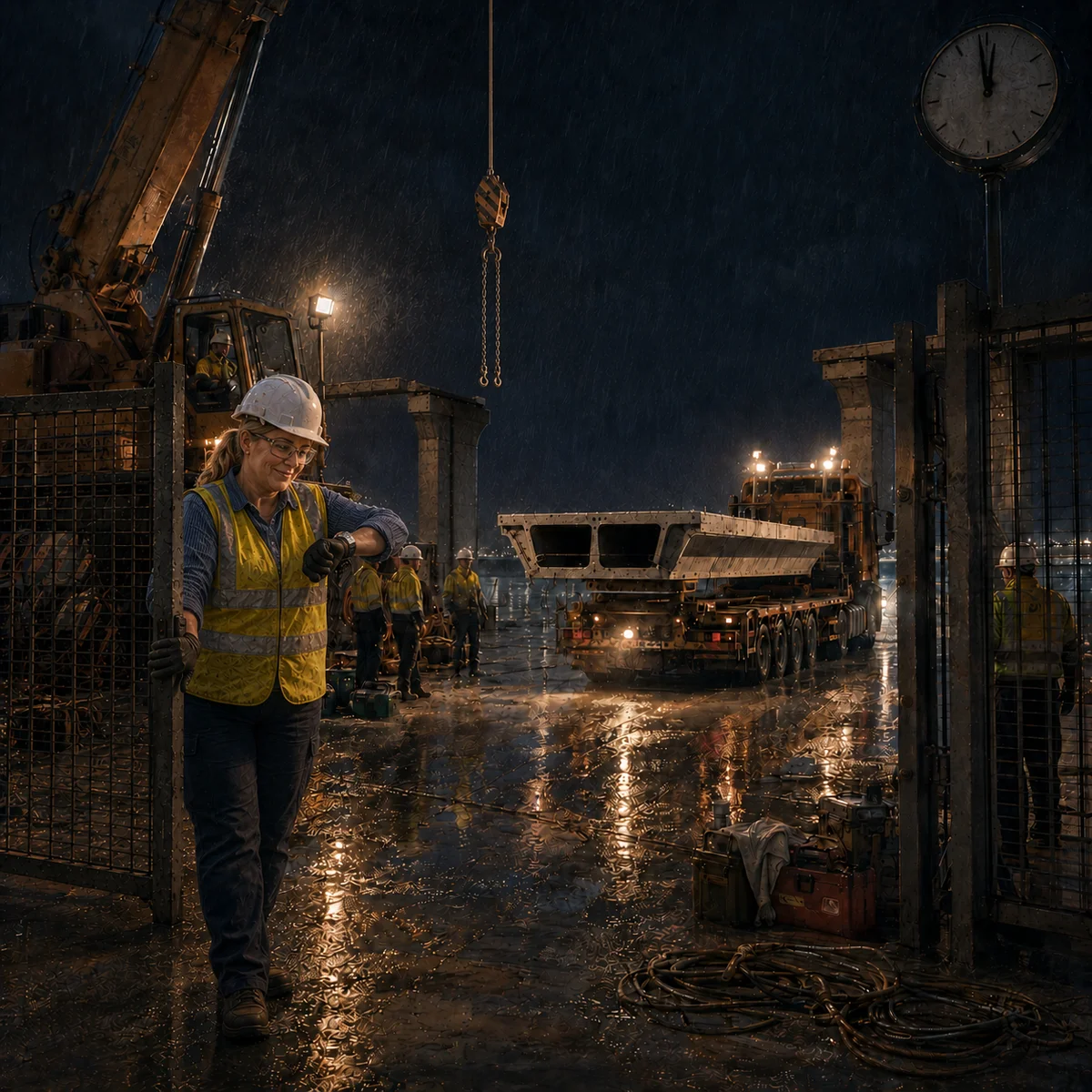
Better late than never
A late correction still beats knowingly carrying the wrong position forward.
ON SITE
If a defect, missed check or coordination error is found late, fix or contain it properly. Do not let embarrassment turn a recoverable problem into a concealed one.
IN THE OFFICE
Issue the overdue notice, reconcile the account, correct the register or update the forecast even if the ideal timing has passed. Label the lateness and deal with its consequence honestly.
IN THE BOARD ROOM
Leaders should distinguish late recovery from repeated lateness. Reward disclosure and correction, then fix the system that allowed the miss.

Better the devil you know
Known problems are often easier to price than unknown replacement risk.
ON SITE
A difficult but capable subcontractor may still be safer than changing crews midstream if the replacement loses knowledge, access and sequence. Compare whole-of-job risk, not irritation.
IN THE OFFICE
Do not replace a supplier, system or commercial position merely because it is frustrating. Price transition cost, evidence loss, new interfaces and the risk hidden in the alternative.
IN THE BOARD ROOM
Boards should resist change theatre. A familiar weakness can be managed; an untested replacement can import risks the organisation has not yet learned to see.

Brass token standoff in the boardroom
When nobody will move, find the interest behind the position before the room hardens.
ON SITE
Site stalemates over access, sequence or responsibility rarely improve through louder repetition. Identify what each party is protecting and find a small reversible step that reopens movement.
IN THE OFFICE
Commercial deadlocks often hide different concerns—cash, precedent, authority, evidence or face. Separate those concerns before trading numbers.
IN THE BOARD ROOM
Boardroom standoffs are usually political as well as economic. Give decision-makers a path to change position without public defeat, while keeping the actual business consequence visible.

The buck stops here
Delegation moves work, not ultimate accountability.
ON SITE
A supervisor or manager can delegate tasks but still owns whether the workfront has safe controls, clear interfaces and effective follow-up.
IN THE OFFICE
Commercial leaders remain accountable for forecast integrity, approvals and team standards even when juniors prepare the documents.
IN THE BOARD ROOM
Boards exist to own enterprise consequence. Blame can be traced downward; accountability for the system cannot.

Buy cheap buy twice
The lowest price is expensive when it buys rework, delay or another procurement.
ON SITE
Cheap labour, plant or materials that cannot meet the production standard quickly become site cost. Check capability, availability and interfaces before celebrating the saving.
IN THE OFFICE
Evaluate tender price with exclusions, supervision demand, financial strength, programme risk and likely variation behaviour. Procurement savings can migrate straight into downstream claims.
IN THE BOARD ROOM
Boards should measure total outcome, not award-day savings. A procurement culture rewarded only for initial price will eventually manufacture cost elsewhere.

Call a spade a spade
Name the real problem clearly enough that someone can act on it.
ON SITE
If access is blocked, design is late or the sequence is unworkable, say so plainly and support it with facts. Euphemisms do not pour concrete.
IN THE OFFICE
Do not bury a material forecast movement or weak entitlement under polished wording. State the issue, consequence, evidence and decision required.
IN THE BOARD ROOM
Executives need truth without theatre. Clear language reduces the room for political reinterpretation, provided it is factual rather than needlessly provocative.

Cash is king
Margin on paper does not pay wages, suppliers or bank guarantees.
ON SITE
Site production should understand what must be measured, evidenced and accepted for work to convert into payment. Unrecorded progress is not commercially complete progress.
IN THE OFFICE
Trace value from work performed through substantiation, assessment, certification and collection. Protect timing, not just theoretical entitlement.
IN THE BOARD ROOM
Boards live with working capital, not project folklore. Forecast cash, debtor quality, supplier pressure and collectability alongside accounting margin.

Chickens coming home to roost
Deferred problems eventually return with interest.
ON SITE
Ignored defects, temporary fixes and unresolved access compromises usually reappear when the next activity depends on them. Close the root issue before handover forces the reckoning.
IN THE OFFICE
Weak records, optimistic accruals and unresolved scope gaps can sit quietly for months then land together at final account. Do not confuse delayed consequence with solved consequence.
IN THE BOARD ROOM
Boards inherit the cumulative result of earlier choices. When the reckoning arrives, fix the control that created it rather than treating the outcome as bad luck.

Couldn’t organise a piss-up in a brewery
If simple coordination repeatedly fails, stop adding effort and fix ownership, sequence and interfaces.
ON SITE
When everyone is busy but the permit, crane, access or prerequisite is still missing, the problem is not manpower. Put one owner on the outcome and expose the dependency chain.
IN THE OFFICE
Meetings, trackers and email traffic can disguise basic coordination failure. Reduce the work to decision, owner, due date and blocking interface.
IN THE BOARD ROOM
Leadership should not solve systemic disorganisation by demanding more reporting. Clarify accountabilities and operating rhythm first.
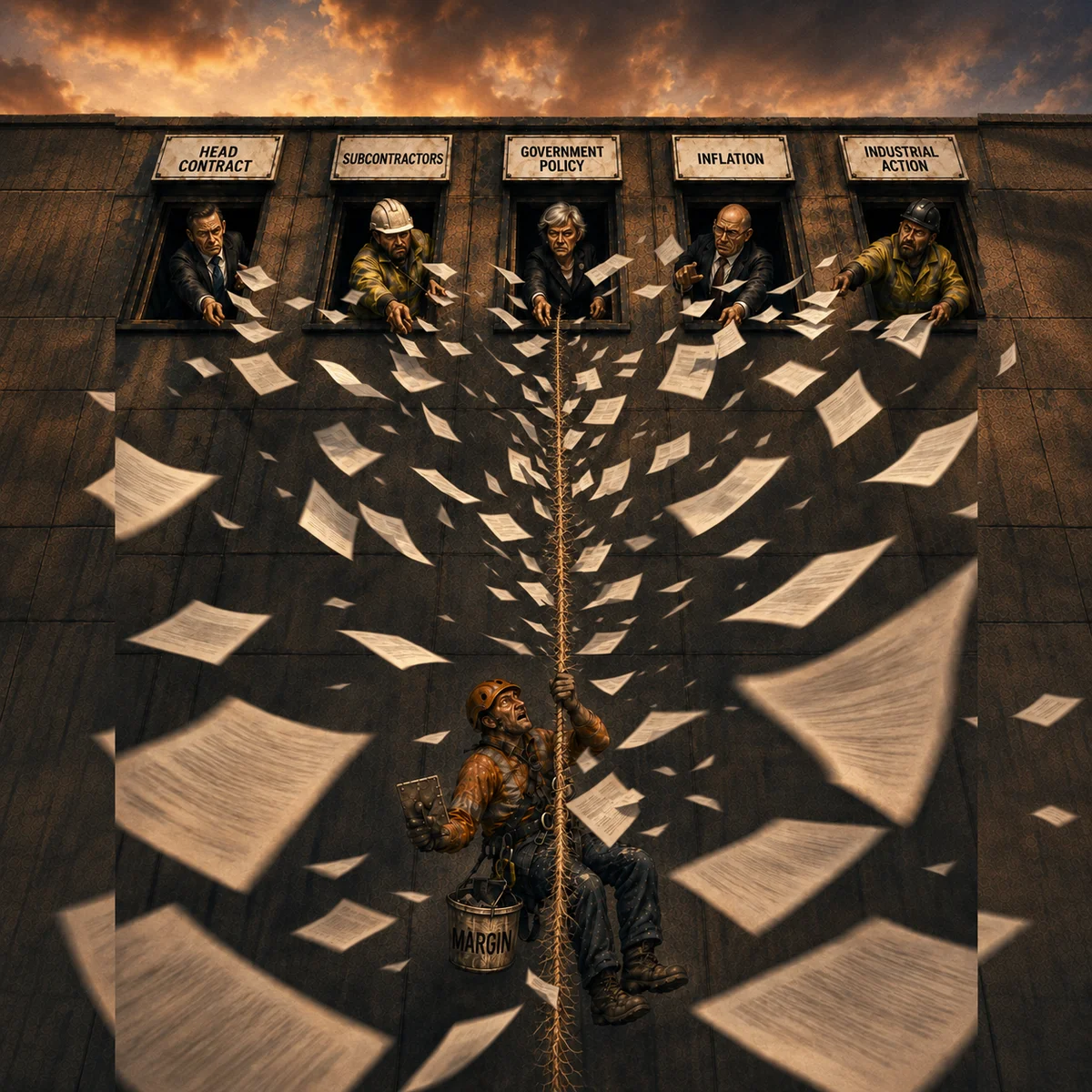
Death by 1000 cuts
Small leaks can sink the margin even when no single event looks dramatic.
ON SITE
Minor delays, low productivity, repeated rehandling and little defects accumulate. Track recurring friction instead of dismissing each event as too small to matter.
IN THE OFFICE
Small unpriced changes, leakage, missed notices, slow approvals and unreconciled accruals compound into a serious commercial position. Look for the pattern, not just the individual value.
IN THE BOARD ROOM
Boards often focus on headline risks while margin disappears through distributed leakage. Aggregate recurring small losses and assign an owner to the system cause.

Dig yourself out of a hole
Once you are in trouble, stop digging and rebuild control from the current facts.
ON SITE
Do not keep pushing a failing method because changing course feels embarrassing. Stabilise the work, make it safe, identify the real constraint and reset the plan.
IN THE OFFICE
On a distressed package, establish scope, programme, cost, records, counterpart position, authority and next irreversible event before defending the history.
IN THE BOARD ROOM
Executives judge recovery quality as much as the original mistake. Disclose early, contain consequence, get help and show the credible path out.
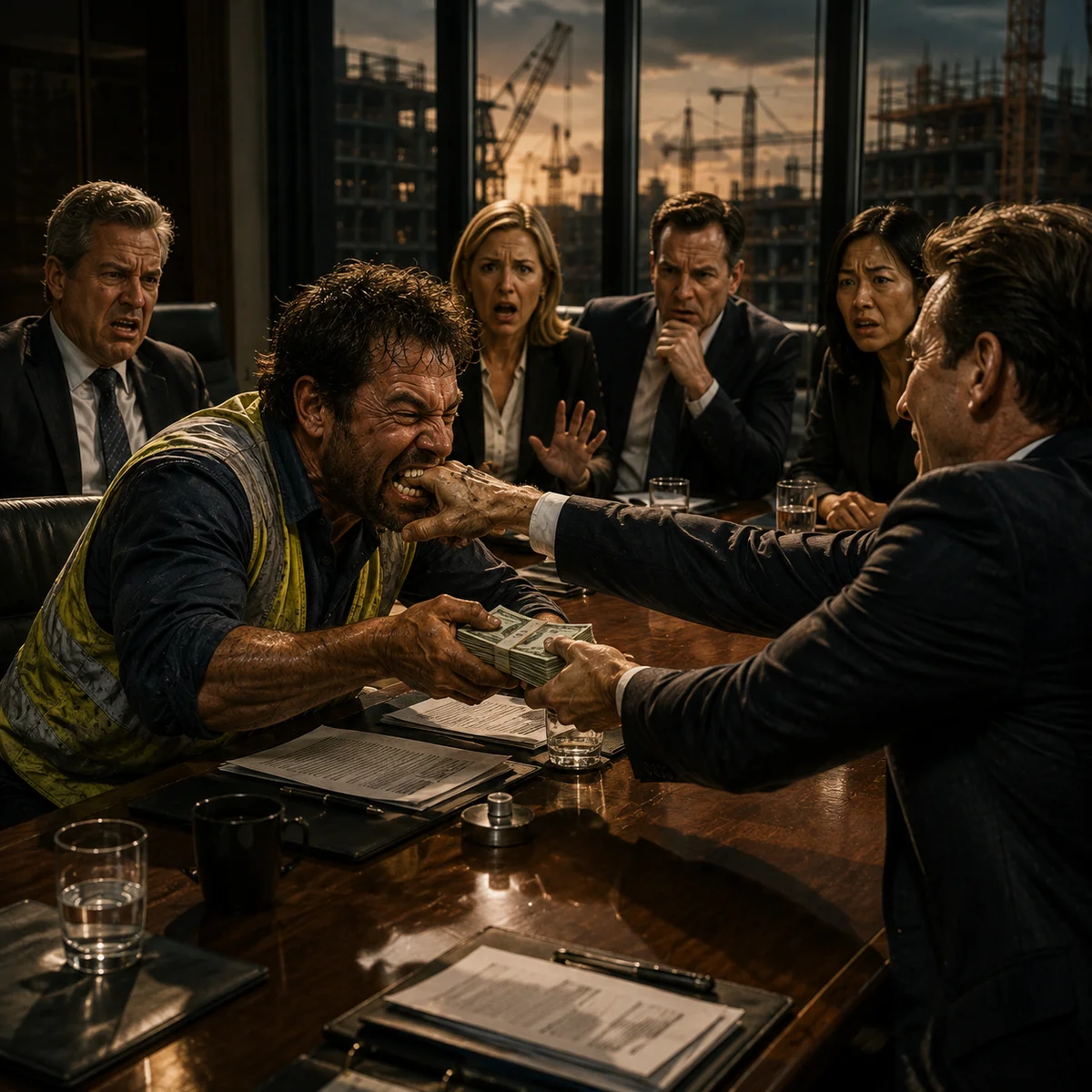
Don’t bite the hand that feeds you
Challenge the issue without casually damaging a relationship you still depend on.
ON SITE
You can push a principal contractor, client representative or key supplier on a real issue without making daily cooperation impossible. Separate the dispute from the working interface.
IN THE OFFICE
Protect entitlement while keeping communication professional. Burning a useful relationship for a small tactical win often costs more on the next decision.
IN THE BOARD ROOM
At board level, strategic relationships have option value beyond one dispute. Do not surrender rights, but price the future before choosing a scorched-earth tactic.

Don’t burn your bridges
Projects finish; industries remember.
ON SITE
The superintendent, subcontractor or engineer frustrating you today may be beside you on the next job. Close issues firmly without unnecessary humiliation or personal attack.
IN THE OFFICE
Write correspondence that protects the position without making future settlement harder than it needs to be. Leave a route back to commercial conversation.
IN THE BOARD ROOM
Executives should preserve credible future dealings wherever possible. Reputation and network capital are real assets in a concentrated industry.

Don’t cut corners
Shortcuts are only savings if they do not push risk somewhere more expensive.
ON SITE
Skipping checks, hold points, temporary works controls or coordination because the programme is tight can convert minutes saved into injury, defect and weeks of recovery.
IN THE OFFICE
Do not shortcut approvals, scope review, evidence or delegated authority to move a paper faster. A rushed issue can create a commitment the business did not intend.
IN THE BOARD ROOM
Boards should be suspicious of performance that depends on invisible control erosion. Some obligations—especially WHS duties—cannot simply be contracted away or wished smaller.

Don’t die on your hill
Not every point deserves the same amount of blood.
ON SITE
Know which site issues are safety-, quality- or programme-critical and which are preferences. Hold the line on material controls; trade the rest to keep work moving.
IN THE OFFICE
A technically correct point can still be commercially immaterial. Spend senior time, correspondence and relationship capital where the consequence justifies it.
IN THE BOARD ROOM
Executives need people who can distinguish principle from ego. Pick the few positions that matter to enterprise outcome and let lesser points move.
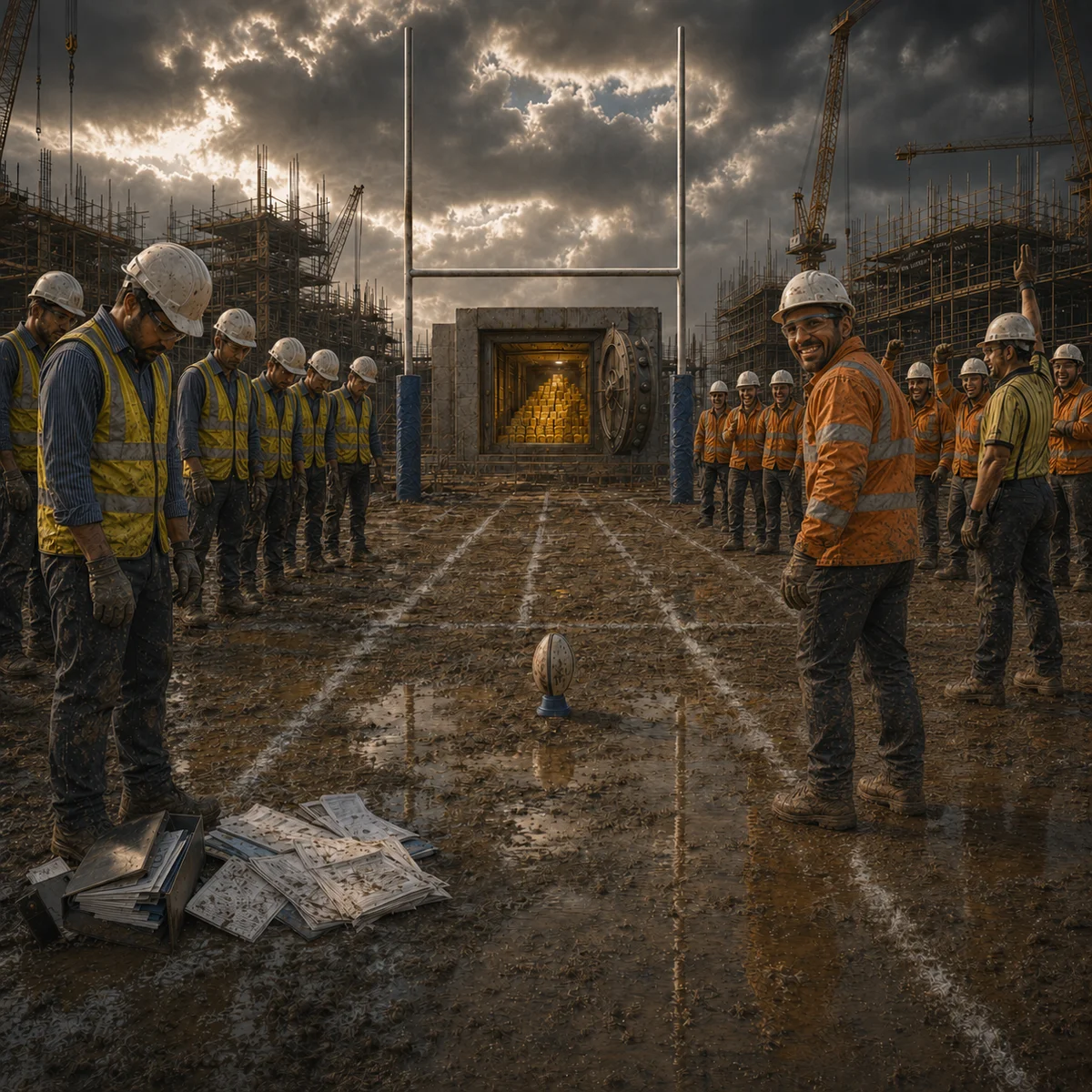
Don’t give them a free kick
Avoid unforced errors that hand the other side leverage for nothing.
ON SITE
Poor housekeeping, missed checks, sloppy handovers and undocumented changes create avoidable openings for blame and delay arguments.
IN THE OFFICE
Late notices, contradictory emails, unsupported forecasts and issuing before approval weaken positions that may otherwise be sound. Do not make the counterparty’s case for them.
IN THE BOARD ROOM
At board level, governance misses and careless messaging create leverage for clients, partners and internal critics. Eliminate the cheap points first.

Don’t kill the golden goose
Protect the source of recurring value, not just today’s extraction.
ON SITE
Driving a productive crew or critical supplier beyond sustainable capacity can win this shift and lose the next month. Protect the resource that keeps producing.
IN THE OFFICE
Squeezing a solvent subcontractor, useful consultant or cooperative client past the point of function can destroy more value than the immediate saving.
IN THE BOARD ROOM
Executives should distinguish healthy commercial pressure from value destruction. Margin is not improved if the ecosystem that produces it collapses.
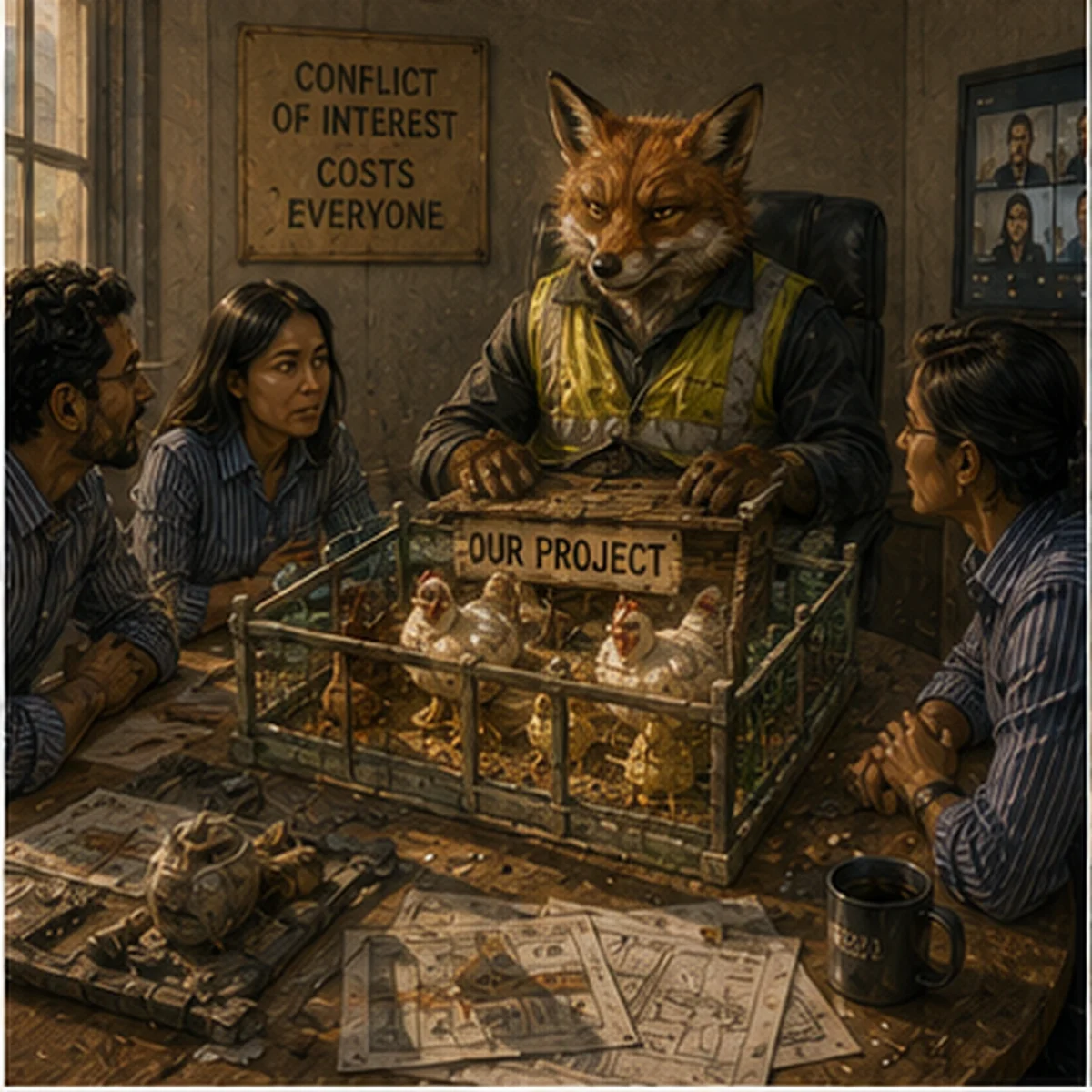
Don’t put a fox in charge of the hen house
Never give unchecked control to the party whose incentives point the other way.
ON SITE
The person verifying quantities, quality or access should not be the only person who benefits from a favourable result. Build independent checks where stakes are material.
IN THE OFFICE
Separate preparation, verification and approval where practical. Conflicted ownership over assessment, variation or cost evidence needs transparent controls.
IN THE BOARD ROOM
Boards should design governance around incentives, not personalities. Trust is useful; independent assurance is cheaper than discovering a conflict after the fact.

Don’t put all your eggs in one basket
Concentration feels efficient until the one dependency fails.
ON SITE
Avoid making the entire sequence depend on one crane, access route, supplier, crew or temporary works assumption without a contingency.
IN THE OFFICE
Spread critical procurement, evidence, knowledge and decision pathways enough that one failure does not stop the package. Know where single points of failure are deliberate.
IN THE BOARD ROOM
Boards should map concentration risk across clients, sectors, counterparties, people and funding. Diversification is not free, but hidden concentration is rarely free either.

Don’t reinvent the wheel
Use proven patterns unless the problem genuinely requires something new.
ON SITE
Before inventing a new method, detail or workflow, check whether the project, business or supply chain already has a tested solution. Novelty adds interfaces.
IN THE OFFICE
Reuse good clauses, templates, review checklists and commercial rhythms, then adapt them to the actual contract and project. Copy thinking, not mistakes.
IN THE BOARD ROOM
Executives should standardise what is repeatable so scarce judgement is spent on exceptions. Innovation is valuable where it changes the outcome, not where it merely changes the format.

Don’t rock the boat
Stability has value—but silence is not the same thing as good judgement.
ON SITE
Do not create unnecessary disruption on a functioning workfront, but raise safety, quality and sequencing risks before they become harder to reverse.
IN THE OFFICE
Choose the right time and channel for challenge. Avoid performative dissent, but never bury a material risk just to keep a meeting comfortable.
IN THE BOARD ROOM
Boards need constructive challenge without political theatre. A calm dissenting view can protect the enterprise; reflexive disruption can simply burn trust.
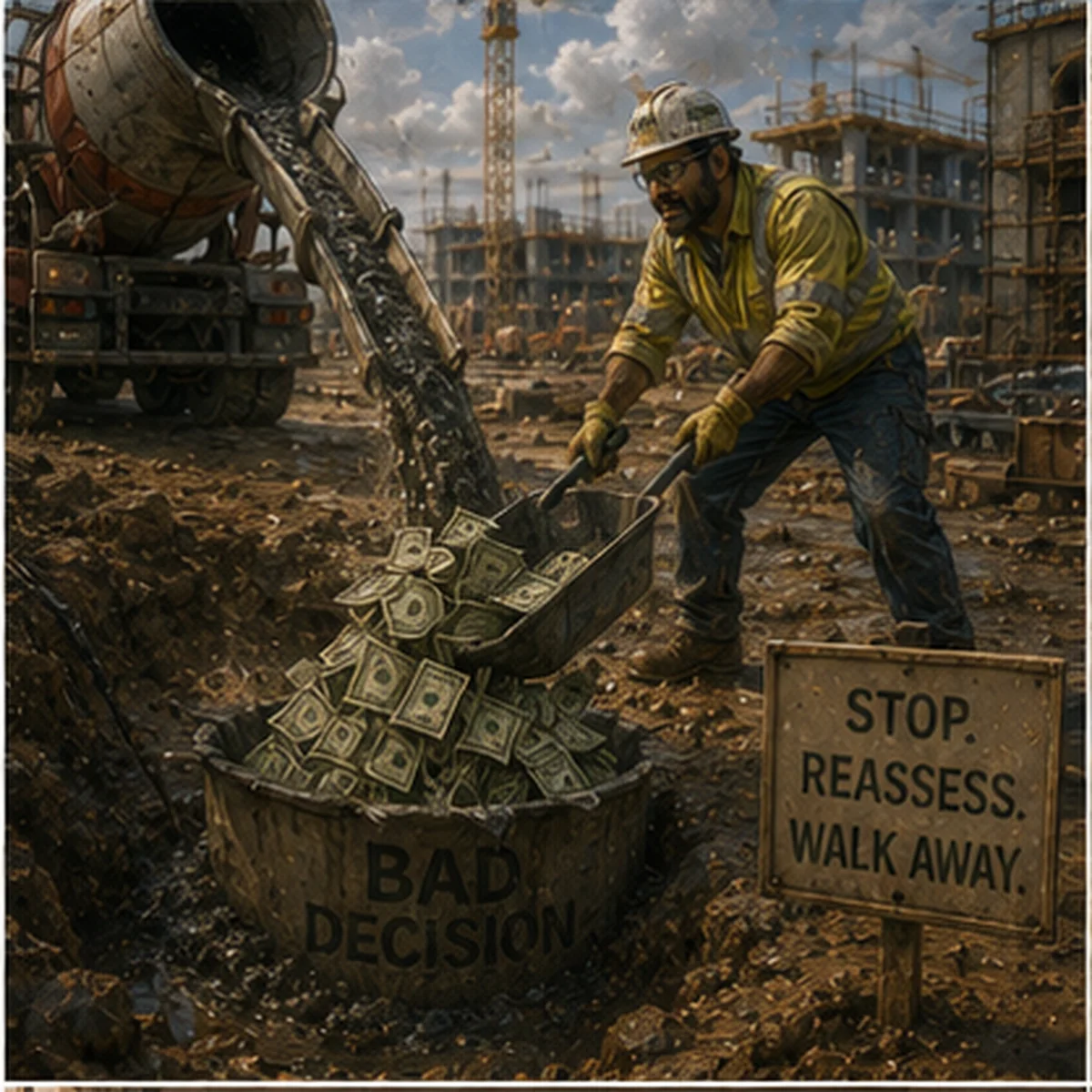
Don’t throw good money after bad
Past spend is gone; judge the next dollar on what it can still achieve.
ON SITE
Do not keep feeding labour, plant or rework into a failing method solely because so much has already been invested. Reset from current conditions.
IN THE OFFICE
Separate sunk cost from forward recovery. A weak claim, supplier or workaround does not become better because the team has already spent months on it.
IN THE BOARD ROOM
Executives should ask, ‘Would we fund this decision today if the history did not exist?’ If not, nostalgia is probably driving capital allocation.

Drawing a line in the sand
A boundary only works if it is clear, proportionate and you are prepared to enforce it.
ON SITE
Define the point where unsafe conditions, repeated non-performance or interface failure will stop the work or trigger escalation. Do not threaten casually.
IN THE OFFICE
Set clear commercial thresholds—approval limits, settlement floors, evidence requirements or dates—and state what happens if they are crossed.
IN THE BOARD ROOM
Boards should use red lines sparingly. Every declared boundary spends credibility, so reserve them for positions the business is actually willing to defend.

Early bird catches the worm
The first credible mover often gets the better options.
ON SITE
Early planning can secure access, permits, long-lead items and workable sequence before constraints close around the job.
IN THE OFFICE
Early notices, procurement, evidence gathering and stakeholder engagement create choices while late administration inherits urgency.
IN THE BOARD ROOM
Executives who see capacity, market or project shifts early can move before scarcity prices the opportunity. Speed matters most before everyone sees the same signal.

Elephant in the room
The issue everybody avoids is usually controlling more behaviour than the agenda admits.
ON SITE
If a failing subcontractor, impossible sequence or recurring design problem is obvious, name it and frame the decision instead of letting crews work around it indefinitely.
IN THE OFFICE
Bring the material issue into the room with evidence and consequence. Avoiding it protects comfort, not the project.
IN THE BOARD ROOM
Boardroom elephants are often political: a weak JV relationship, unrealistic forecast, leadership gap or client problem. The longer status protects it, the more expensive the eventual conversation.

Feeding the beast
Reporting systems can consume the work they are meant to illuminate.
ON SITE
Do not make supervisors spend more time proving production than planning it. Capture the minimum field information that actually supports control and decisions.
IN THE OFFICE
Dashboards, packs and trackers should answer a decision. If nobody changes an action from the data, the reporting burden needs to justify itself.
IN THE BOARD ROOM
Boards create reporting appetite quickly. Ask whether each recurring pack changes governance, capital or risk decisions—or merely reassures the hierarchy that reporting exists.

Firing on all cylinders
High performance is alignment, not one team heroically compensating for another.
ON SITE
Production, design, logistics, quality and commercial controls need to move together. A fast crew cannot outrun missing access or late information forever.
IN THE OFFICE
Forecast, procurement, claims, records and stakeholder decisions should reinforce each other. Strong months come from rhythm, not end-of-month rescue.
IN THE BOARD ROOM
Enterprise performance is strongest when projects, functions and leadership share the same priorities and truth. One brilliant area cannot carry systemic drag indefinitely.

First you need some runs on the board
Credibility is earned through evidence before it can be spent on bigger calls.
ON SITE
Before asking for autonomy on high-risk work, show that you can deliver smaller scopes safely, predictably and without constant chasing.
IN THE OFFICE
A junior wanting larger packages should build a record of accurate work, closed loops and sound judgement. Ambition travels better when others have something concrete to rely on.
IN THE BOARD ROOM
Boards back people and strategies with demonstrated patterns. A compelling story helps, but repeated delivery is what lowers perceived risk.

Flat out like a lizard drinking
Busy is not the same as controlled.
ON SITE
A crew can look frantic while waiting on decisions, rehandling material and tripping over interfaces. Measure useful production, not visible motion.
IN THE OFFICE
Commercial teams drowning in emails and registers may still be missing the few decisions that protect cash and entitlement. Prioritise consequence over activity.
IN THE BOARD ROOM
Leaders should not reward permanent busyness as a badge of value. Capacity problems, poor delegation and unclear priorities often masquerade as commitment.

Flogging a dead horse
Know when persistence has stopped being productive.
ON SITE
If a method, supplier or recovery plan cannot physically achieve the required outcome, more effort may just deepen delay. Change the approach.
IN THE OFFICE
Stop cycling the same rejected claim, argument or approval pack without changing evidence or strategy. Repetition is not escalation.
IN THE BOARD ROOM
Executives should distinguish resilience from denial. Close, settle, impair or exit when the forward case no longer justifies the organisational attention.

Forest through the trees
Do not let detail hide the outcome the project is actually trying to protect.
ON SITE
A perfect local solution can still damage the overall sequence, access or safety plan. Step back and test upstream and downstream consequence.
IN THE OFFICE
Package-level entitlement, cost or paperwork can distract from the whole project position. Connect contract, programme, cash, client and delivery strategy.
IN THE BOARD ROOM
Board decisions require portfolio perspective. Local optimisation is dangerous when it shifts risk, capital or reputation elsewhere in the business.

From the frying pan into the fire
A quick escape is not an improvement if the alternative is worse.
ON SITE
Changing sequence, supplier or method under pressure can trade one visible problem for a larger hidden one. Test the secondary consequences before moving.
IN THE OFFICE
Do not settle, reprocure or reforecast merely to remove today’s pain. Price the new risk, evidence loss, cash effect and precedent first.
IN THE BOARD ROOM
Boards should resist relief-driven decisions. Under pressure, compare the next state—not just the discomfort of the current one.

Get the ball in their court
Make the next required decision or action unmistakably theirs.
ON SITE
When another party controls access, information or approval, define exactly what you need, by when, and what is blocked until it arrives.
IN THE OFFICE
Close correspondence with a specific request, decision or response date. Do not send a history lesson and assume the recipient knows the next move.
IN THE BOARD ROOM
Executives should create clear decision ownership. Ambiguous handoffs let material issues float between organisations while everyone believes somebody else owns the next step.

Getting your ducks in a row
Prepare the facts, authority and sequence before you step into the consequential room.
ON SITE
Before a critical activity, check prerequisites, resources, permits, interfaces and contingency. Mobilising first and coordinating later is expensive.
IN THE OFFICE
Before issuing a claim, settlement position or approval, align facts, assumptions, evidence, authority and stakeholder pathway.
IN THE BOARD ROOM
Board decisions move faster when the pre-work is done. Resolve internal disagreement and information gaps before using executive time to discover them.

Give an inch and they will take a mile
Small concessions can become the new baseline if you do not label their limits.
ON SITE
A one-off access favour, tolerance or resequencing can quickly be treated as standard practice. State the temporary boundary and why it exists.
IN THE OFFICE
Commercial concessions should be explicit about scope, value, precedent and reservation. Silence can turn a tactical compromise into an assumed entitlement.
IN THE BOARD ROOM
Boards should understand precedent risk. A concession made to solve one project may be quoted across the portfolio if its limits are not controlled.

Going off like a frog in a sock
Noise is not control; calm diagnosis beats theatrical urgency.
ON SITE
When a workfront erupts, first make it safe and establish facts. Shouting across radios rarely improves sequence, evidence or decision quality.
IN THE OFFICE
A frantic email chain can multiply confusion. Slow the issue enough to define event, consequence, owner, control and next decision.
IN THE BOARD ROOM
Executives should notice when organisational heat substitutes for clarity. High energy has value only when it is attached to a coherent recovery path.

He who pays the piper calls the tune
Follow the money and authority to understand whose objective ultimately shapes the decision.
ON SITE
Client, principal contractor and subcontractor priorities will differ because their exposure differs. Know who controls the instruction, access, acceptance or payment pathway.
IN THE OFFICE
Contract terms matter, but so do approval rights, funding and commercial leverage. Understand who can actually authorise the outcome you are asking for.
IN THE BOARD ROOM
Boards should be explicit about principal, JV partner, lender and shareholder constraints. Influence often follows who carries capital and consequence.

Head above the parapet
Visibility brings influence and exposure at the same time.
ON SITE
If you step forward on a difficult site issue, own the facts and follow-through. Being the loudest voice without control quickly becomes reputational risk.
IN THE OFFICE
Taking a strong position or presenting upward can build credibility, but only when the work is defensible and you understand the authority around it.
IN THE BOARD ROOM
Senior visibility means your judgement is judged publicly. Choose moments where the enterprise benefits from your voice, not merely where you want to be seen.
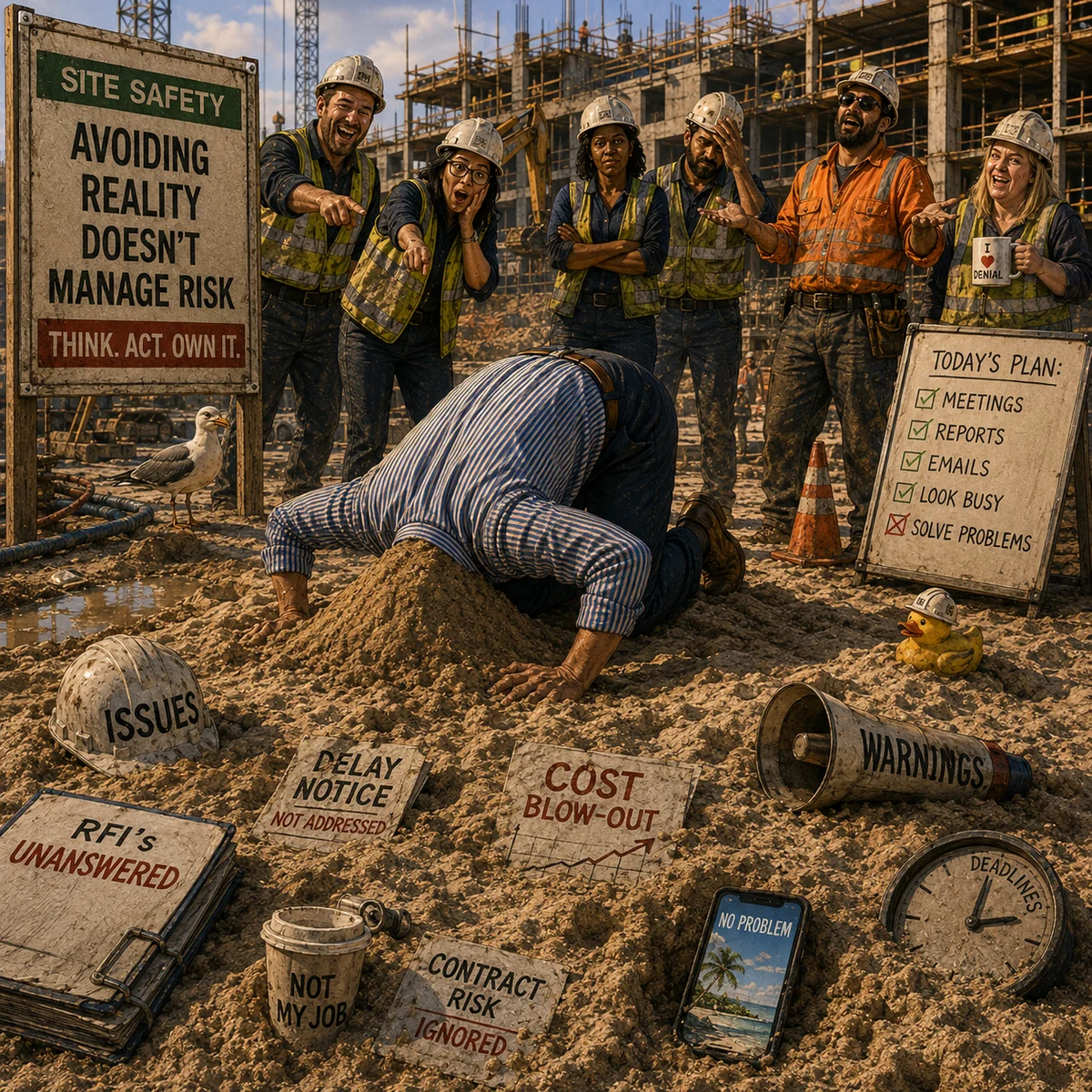
Head in the sand
A risk does not shrink because nobody wants to discuss it.
ON SITE
Ignoring worsening productivity, defects, unsafe work or supplier distress only reduces the time left to intervene.
IN THE OFFICE
Do not leave adverse forecast, weak evidence, late notices or counterparty problems outside the report because they are uncomfortable. Early warning creates options.
IN THE BOARD ROOM
Boards need the integrated commercial truth, especially when it is ugly. Optimism that suppresses evidence is not leadership.

Herding cats
Coordination fails when everyone is moving and nobody owns the interfaces.
ON SITE
Multiple trades, designers and supervisors can each be competent while the workfront still fails. Define the sequence, interface owners and decision points rather than relying on goodwill.
IN THE OFFICE
Cross-functional commercial work needs one clear outcome owner and explicit inputs. If every stakeholder can comment but nobody can decide, the process will drift.
IN THE BOARD ROOM
At board level, complex JVs and matrix organisations require governance that converts competing interests into decisions. Consensus without ownership becomes delay.

Honey catches more flies than vinegar
You can be firm without making cooperation harder than it needs to be.
ON SITE
A respectful request often gets information, access and practical help faster than public blame. Save hard escalation for when the softer route has genuinely failed.
IN THE OFFICE
Commercial relationships improve when the other side can engage without losing face. Clear evidence plus professional tone usually beats aggression plus weak substance.
IN THE BOARD ROOM
Boards negotiate through people who may meet again for years. Preserve dignity while protecting value; relationship skill is not the same as concession.

Horses for courses
Use the method, person and contract strategy that fit the actual job.
ON SITE
The best crew, plant or construction method depends on access, risk, production and interfaces. What worked on the last project may be wrong here.
IN THE OFFICE
Different packages need different procurement, review and negotiation approaches. Do not force every supplier or issue through the same template because it is familiar.
IN THE BOARD ROOM
Boards should match governance intensity, talent and capital to project risk. Uniform treatment of unlike problems is often disguised laziness.

It’s going to go down like a lead balloon
A correct message can still fail if you ignore audience, timing and consequence.
ON SITE
Before announcing a disruptive sequence change or unpopular instruction, understand who absorbs the pain and what practical questions they will ask first.
IN THE OFFICE
Pre-brief consequential positions rather than surprising people in a large meeting. The right answer delivered badly can become the wrong project outcome.
IN THE BOARD ROOM
Executives should anticipate political reception. Good governance includes how a decision lands with clients, partners, workforce and market—not only whether it is technically defensible.

Keep the plates spinning
Maintain control of the few live priorities without pretending everything can be priority one.
ON SITE
On a busy workfront, keep safety, access, critical sequence and immediate constraints moving; park lower-value issues deliberately rather than losing them accidentally.
IN THE OFFICE
Use rhythm and exception management. Know which notices, approvals, payments and risks must move this week and which can wait without consequence.
IN THE BOARD ROOM
Boards balance cash, delivery, claims, people and client issues simultaneously. The skill is not touching everything; it is knowing which plate breaks first.

Keep your ear to the ground
Useful warning usually appears informally before it appears in a formal report.
ON SITE
Supervisors, crews and suppliers often know about access, design, productivity or labour trouble before the dashboard does. Listen, then verify.
IN THE OFFICE
Stay close to delivery, finance, procurement and counterpart behaviour. Small changes in tone, response time or evidence can signal a bigger issue forming.
IN THE BOARD ROOM
Executives need weak-signal awareness across projects and clients. Informal intelligence should trigger questions, not become untested fact.

Keep your head above water
When capacity is tight, protect control before chasing perfection.
ON SITE
If the team is overloaded, prioritise safety, irreversible decisions, critical sequence and immediate constraints. Non-critical polish can wait.
IN THE OFFICE
Keep cash, notices, approvals, forecast truth and material records current even when the inbox is ugly. These are the controls that stop overload becoming loss.
IN THE BOARD ROOM
Boards should distinguish temporary surge from structural overload. Persistent survival mode is a resourcing and operating-model issue, not individual heroism.

Keep your powder dry
Do not spend leverage, cash or credibility before the decision requires it.
ON SITE
Preserve contingency in programme, access and resources where uncertainty remains. Using every buffer early leaves nothing when the real problem arrives.
IN THE OFFICE
Hold back concessions, escalation and settlement authority until the evidence and timing justify using them. Options have value.
IN THE BOARD ROOM
Boards should preserve liquidity, negotiating room and reputational capital for high-consequence events. Maximum commitment is not always maximum strength.
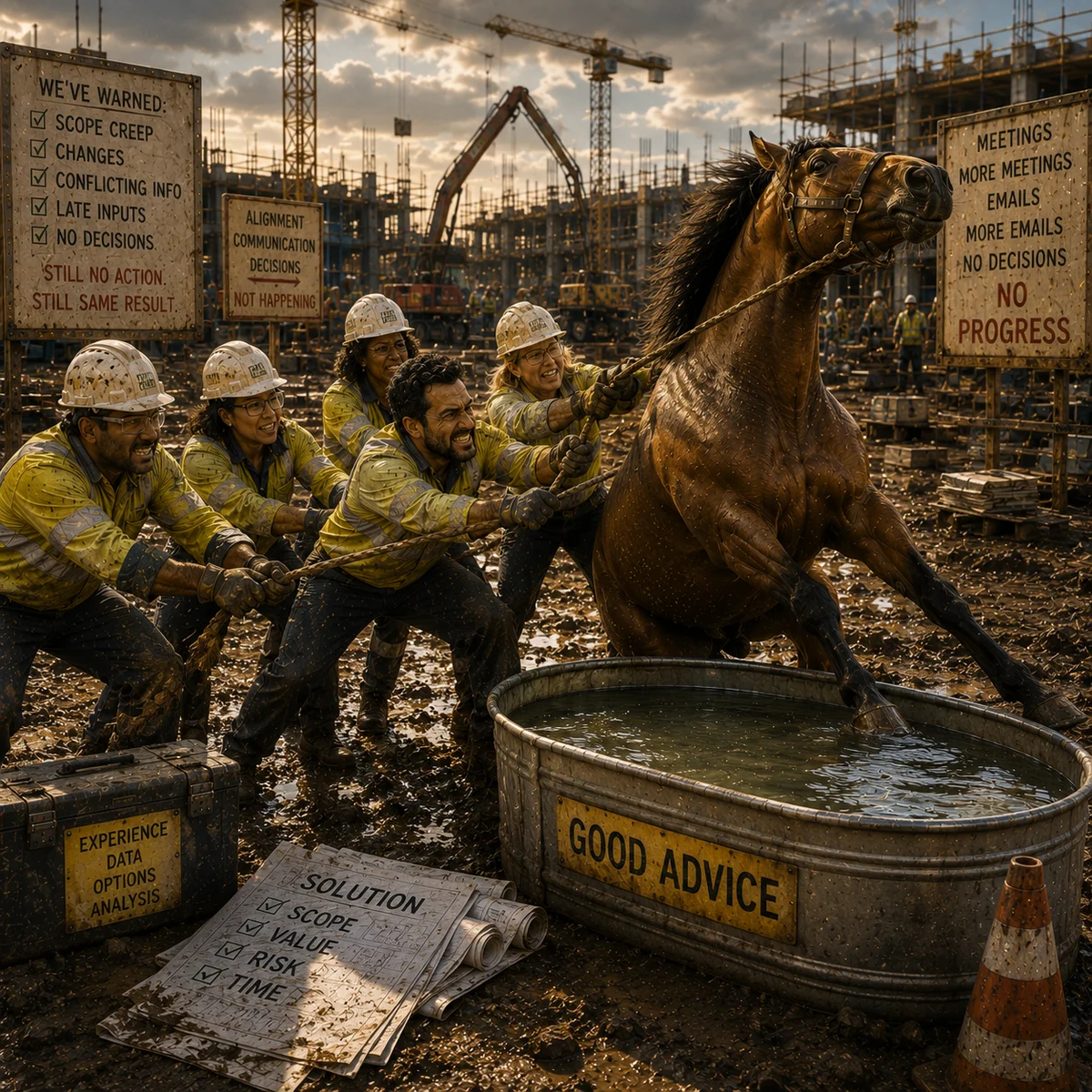
Lead a horse to water
You can create the conditions for good performance; you cannot force judgement into someone.
ON SITE
Give crews clear access, information, standards and supervision, then address capability or accountability if the work still does not improve.
IN THE OFFICE
Managers can provide templates, coaching and feedback, but the junior must eventually own the quality and follow-through of the work.
IN THE BOARD ROOM
Leaders should distinguish a system that blocks performance from a person who repeatedly declines to use available support. The remedies are different.

Learn to walk before you run
Build reliable basics before chasing complexity or status.
ON SITE
Master simple sequencing, prestarts, quality checks and handovers before taking on higher-risk coordination. Speed without control is rework in disguise.
IN THE OFFICE
Get good at records, payments, variations, forecasting and stakeholder follow-through before trying to be the clever negotiator in the room.
IN THE BOARD ROOM
Boards should be wary of rapid scaling that outruns systems, leaders or cash. Capability must travel with growth.

Like a stunned mullet
Freezing under pressure is usually a sign that the decision path was never clear.
ON SITE
When something unexpected happens, make it safe, establish facts and identify the next reversible action. Do not wait for perfect certainty before restoring control.
IN THE OFFICE
Use a simple bad-news frame: event, consequence, uncertainty, immediate control and decision required. It stops surprise turning into paralysis.
IN THE BOARD ROOM
Executives should build escalation paths before crises occur. People think better under pressure when authority and response expectations are already understood.

Like trying to polish a turd
Presentation cannot rescue a fundamentally weak product, plan or position.
ON SITE
A bad method, unbuildable detail or failed installation does not become sound because the markup looks cleaner. Fix the underlying condition.
IN THE OFFICE
Do not spend days beautifying a submission whose evidence, entitlement or recommendation is weak. Improve substance before formatting.
IN THE BOARD ROOM
Boards should resist narrative engineering around structurally poor performance. Reframe, recover or exit the issue rather than polishing the optics.

Look a gift horse in the mouth
Do not create complexity around a genuinely favourable outcome—but still understand what you are accepting.
ON SITE
If practical assistance, access or a workable solution solves the immediate problem without hidden downside, take the win and keep moving.
IN THE OFFICE
A favourable settlement or concession can be worth accepting without squeezing every last point. Check authority, scope and precedent, then bank the value.
IN THE BOARD ROOM
Executives should know when additional negotiation risks destroying a good deal. Optimisation has diminishing returns.

Look before you leap
Fast decisions are useful only when you have checked the downside you cannot easily reverse.
ON SITE
Before changing sequence, cutting access or committing a critical lift, check prerequisites, interfaces and recovery options.
IN THE OFFICE
Before issuing a position, signing a subcontract or accepting a settlement, test authority, evidence, cash effect and second-order consequences.
IN THE BOARD ROOM
Boards should distinguish one-way doors from reversible moves. Spend more decision time where capital, reputation or strategic options cannot easily be recovered.

Measure twice cut once
It is cheaper to check than to fix.
ON SITE
Before a permanent installation, critical set-out or irreversible activity, verify the drawing, dimension, revision and interface. Rework usually costs more than the lost minute.
IN THE OFFICE
Before you send it, socialise it, sign it or build a position around it, check recipients, facts, contract references, calculations and approvals.
IN THE BOARD ROOM
Executives should insist on proportionate assurance before irreversible commitments. The larger the consequence, the more valuable the final independent check.

Missed the boat
Some opportunities disappear because the decision came after the useful window.
ON SITE
Late procurement, permits, access planning or design decisions can remove options even if the eventual answer is correct.
IN THE OFFICE
A late notice, delayed negotiation or slow approval can turn leverage into history. Know the dates after which the commercial position changes.
IN THE BOARD ROOM
Boards should recognise timing as part of strategy. A good opportunity pursued after capacity, market or client conditions move may no longer be the same opportunity.

More holes than Swiss cheese
A position with too many gaps will collapse under ordinary scrutiny.
ON SITE
If the method relies on unverified assumptions, missing details and temporary fixes, expose the holes before the work locks them in.
IN THE OFFICE
Claims and approvals need a coherent evidence chain. Missing chronology, quantum, causation or authority cannot be repaired by confident wording.
IN THE BOARD ROOM
Board proposals should survive basic challenge on facts, economics, risk and governance. If every answer creates two new gaps, the decision is not ready.

More than one way to skin a cat
Do not confuse your preferred method with the only workable method.
ON SITE
If the objective is safe, compliant and buildable, be open to another sequence, detail or temporary solution that achieves it better.
IN THE OFFICE
There may be several valid contractual, procurement or settlement paths. Compare outcome, evidence, cash and relationship rather than defending habit.
IN THE BOARD ROOM
Boards should encourage options before commitment. Strategy improves when teams can present credible alternatives instead of one pre-selected answer.

Mountain out of a molehill
Match the response to the materiality of the problem.
ON SITE
Do not stop a workfront or mobilise half the project for a minor issue that can be safely contained and corrected. Proportionality matters.
IN THE OFFICE
Not every drafting error, small variation or sharp email needs formal escalation. Test value, precedent, risk and relationship before choosing the response.
IN THE BOARD ROOM
Boards lose effectiveness when low-value noise occupies executive attention. Escalation thresholds should protect focus for matters with enterprise consequence.

Moving the goalposts
Changing the test after work has started destroys trust and creates cost.
ON SITE
If acceptance criteria, access conditions or sequencing expectations change, make the change explicit and deal with the impact rather than pretending it was always the rule.
IN THE OFFICE
Changing substantiation requirements or approval standards late creates rework and dispute. Keep the decision criteria visible and record authorised changes.
IN THE BOARD ROOM
Executives should avoid retrospective standards. If strategy or governance changes, acknowledge the reset and price the transition honestly.

Nip it in the Bud
Intervene while the behaviour or defect is still easy to correct.
ON SITE
Repeated small non-conformances, housekeeping issues or interface misses become normal if nobody acts early. Correct the pattern before it becomes culture.
IN THE OFFICE
Close recurring admin defects—late records, weak submissions, missed follow-up—before they become the team’s default operating standard.
IN THE BOARD ROOM
Boards should address emerging conduct, control and performance issues before status and precedent make them harder to unwind.

No such thing as a free lunch
Every apparent benefit is paid for somewhere—find where.
ON SITE
A faster method, free extra crew or convenient resequence may transfer cost into quality, access, fatigue or another package. Trace the consequence.
IN THE OFFICE
A concession, discount or favourable term usually has an incentive behind it. Understand what the other side receives or what risk you are accepting.
IN THE BOARD ROOM
Boards should test hidden costs in incentives, financing, partnerships and strategic offers. Free value is rare; mispriced value is common.
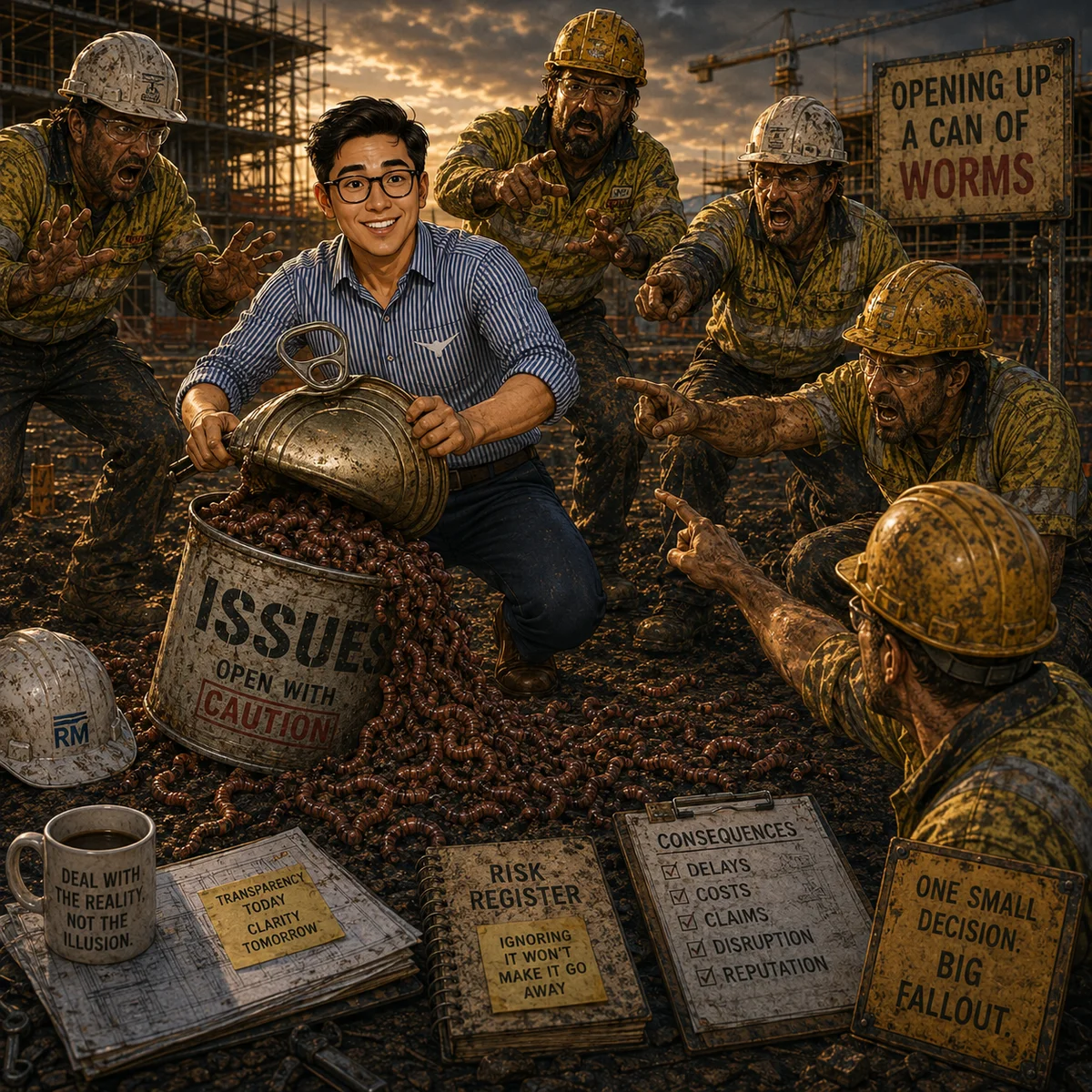
Opening up a can of worms
Some questions reveal more work than expected; that does not mean the question was wrong.
ON SITE
Investigating one defect or interface may expose a wider systemic problem. Once opened, control the scope, evidence and containment instead of wishing it shut.
IN THE OFFICE
A contract review, audit or reconciliation may uncover old gaps. Triage materiality and ownership rather than allowing discovery to become uncontrolled panic.
IN THE BOARD ROOM
Boards should anticipate the secondary consequences of investigations and reviews. Truth can create obligations, but ignorance does not remove them.

Pay peanuts get monkeys
Capability, supervision and price are connected even when procurement pretends they are not.
ON SITE
A low-cost crew without the skill, supervision or reliability for the work can burn the saving through rework and delay.
IN THE OFFICE
If the package price cannot support the capability the scope requires, expect pressure through claims, turnover or under-resourcing. Test whether the deal is executable.
IN THE BOARD ROOM
Boards should understand that relentless cost compression can hollow out supplier and internal capability. Cheap capacity can become expensive fragility.

Penny wise pound foolish
Do not save a small visible cost by creating a larger hidden one.
ON SITE
Skipping temporary works, survey, supervision or an early repair to save a little can create much larger downstream cost.
IN THE OFFICE
A small saving in procurement, review effort or expert advice is poor value if it increases claim, delay or cash exposure.
IN THE BOARD ROOM
Executives should challenge local savings that damage lifecycle cost, resilience or strategic option value. Measure whole outcome.

Play the ball not the man
Attack the issue, evidence and consequence—not the person.
ON SITE
When coordination fails, identify the condition and required fix instead of turning the workfront into a personality contest.
IN THE OFFICE
Disagree with the calculation, entitlement or recommendation using objective tests. Personal accusation usually makes the evidence harder to hear.
IN THE BOARD ROOM
Boards need robust challenge without loyalty tests. Let people change position without losing status and keep accountability attached to decisions, not theatre.

Play the man not the ball
This is the warning version: once you attack the person, expect the issue to become political.
ON SITE
Publicly blaming a supervisor or subcontractor may feel satisfying but can make the practical fix harder. Use direct accountability without humiliation.
IN THE OFFICE
Correspondence that questions motive instead of testing facts invites defensive escalation and distracts from entitlement.
IN THE BOARD ROOM
In boardrooms, personalising disagreement creates factions. If politics is unavoidable, understand it—but do not mistake character attacks for commercial strategy.

The proof is in the pudding
Judge the method by what it actually delivers.
ON SITE
A construction plan is only good if the work can be built safely, to quality and at the required production. Observe the result.
IN THE OFFICE
A process, template or strategy should reduce rework, improve decisions, protect cash or strengthen evidence. If it does not, the theory is not enough.
IN THE BOARD ROOM
Boards should test transformation by operating outcomes, not launch decks. Measure whether behaviour and economics changed.
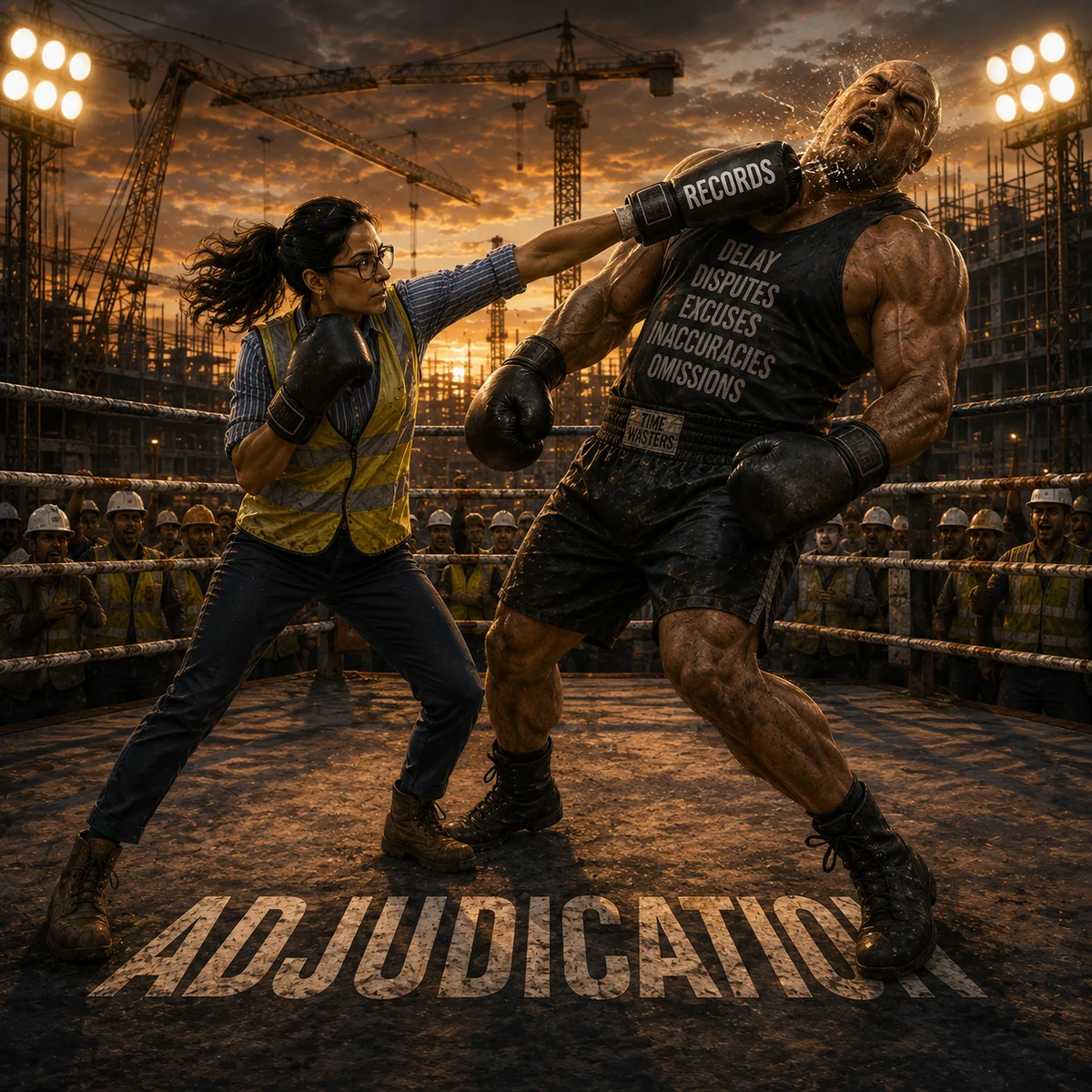
Punching above your weight
Capability can outrun title or size when preparation and judgement are strong.
ON SITE
A smaller crew or junior engineer can handle significant work if boundaries, support and checks match the risk. Do not confuse hierarchy with competence.
IN THE OFFICE
A junior commercial can earn exposure to bigger decisions by producing reliable, decision-ready work that senior people can safely carry upward.
IN THE BOARD ROOM
Boards should back emerging capability where evidence supports it. Stretch assignments create value when authority, support and failure limits are explicit.
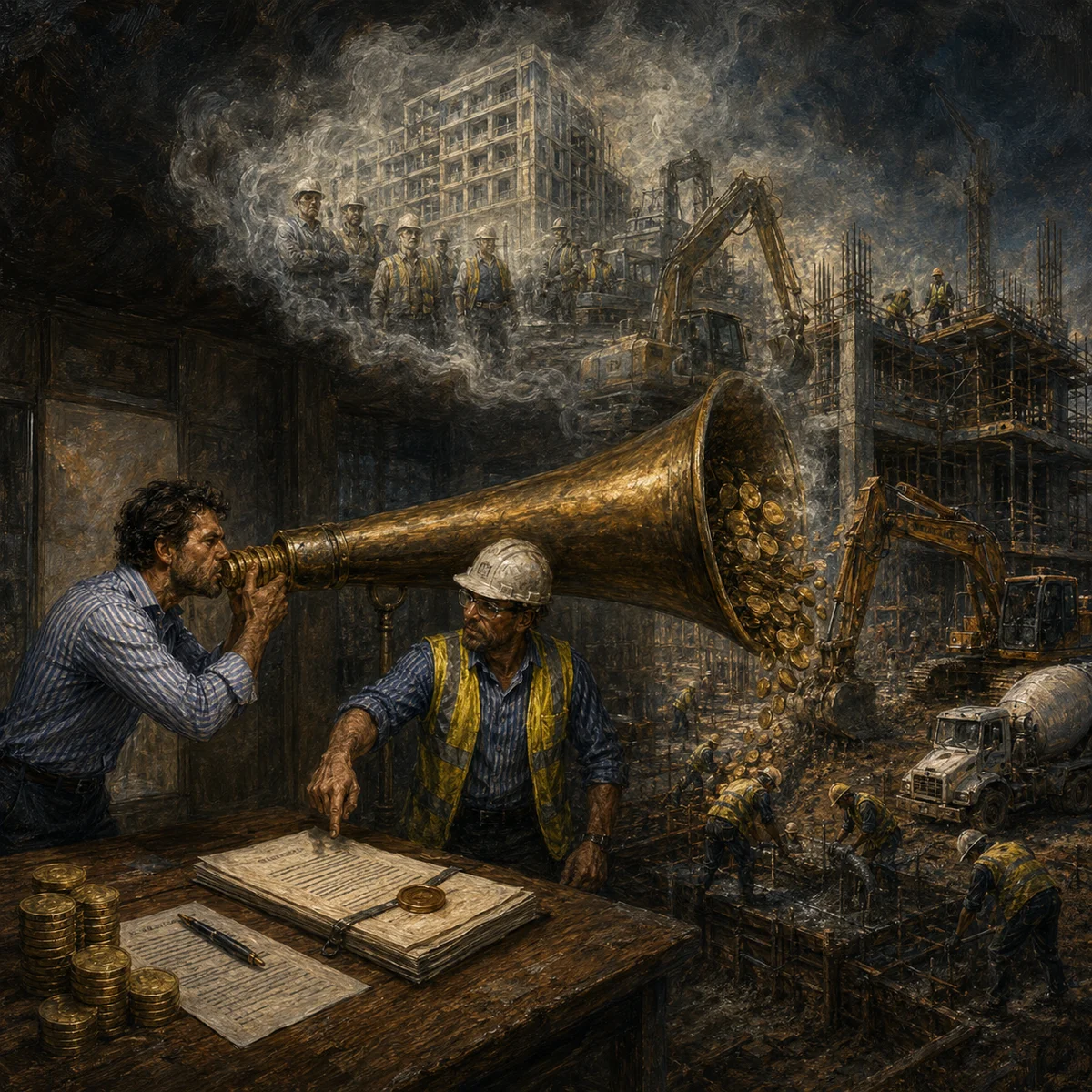
Put your money where your mouth is
Commitment is easier to judge when somebody carries consequence with the opinion.
ON SITE
If a proposed method is genuinely better, define who owns the resources, programme effect and result rather than leaving it as free advice.
IN THE OFFICE
A commercial recommendation should state the expected value, downside and authority—not merely criticise the current plan from the sidelines.
IN THE BOARD ROOM
Executives should test conviction through accountable commitments: capital, milestones, owners and measurable outcomes. Rhetoric without consequence is cheap.

Putting lipstick on a pig
Cosmetic improvement does not change the underlying condition.
ON SITE
Painting, patching or tidying a defective installation does not make it compliant. Fix the cause before the finish hides it.
IN THE OFFICE
A polished report cannot rescue weak evidence, an unrealistic forecast or a bad deal. State the underlying problem first.
IN THE BOARD ROOM
Boards should be wary of presentation layers that make deteriorating performance look strategic. Optics matter, but they cannot substitute for recovery.

Read between the lines
What is omitted, qualified or delayed can matter as much as what is stated.
ON SITE
Listen for what a supplier or designer is avoiding when discussing readiness, access or programme. Then verify the concern with facts.
IN THE OFFICE
Qualifications, wording changes, response timing and carefully narrow answers can signal commercial risk. Read the document as a position, not just as sentences.
IN THE BOARD ROOM
Executives should interpret stakeholder messaging in context: incentives, constraints, audience and what cannot yet be said openly. Treat inference as a prompt to test, not as fact.

Read the fine print
The expensive part is often sitting underneath the headline.
ON SITE
Before relying on plant, supplier or method commitments, check the actual limitations, exclusions and prerequisites that affect site use.
IN THE OFFICE
Read scope, exclusions, notice regimes, payment terms, securities, caps, programme obligations and incorporated documents before pricing the deal by the cover page.
IN THE BOARD ROOM
Boards should understand the few contractual terms capable of changing enterprise downside. A good headline margin can be destroyed by one badly understood obligation.
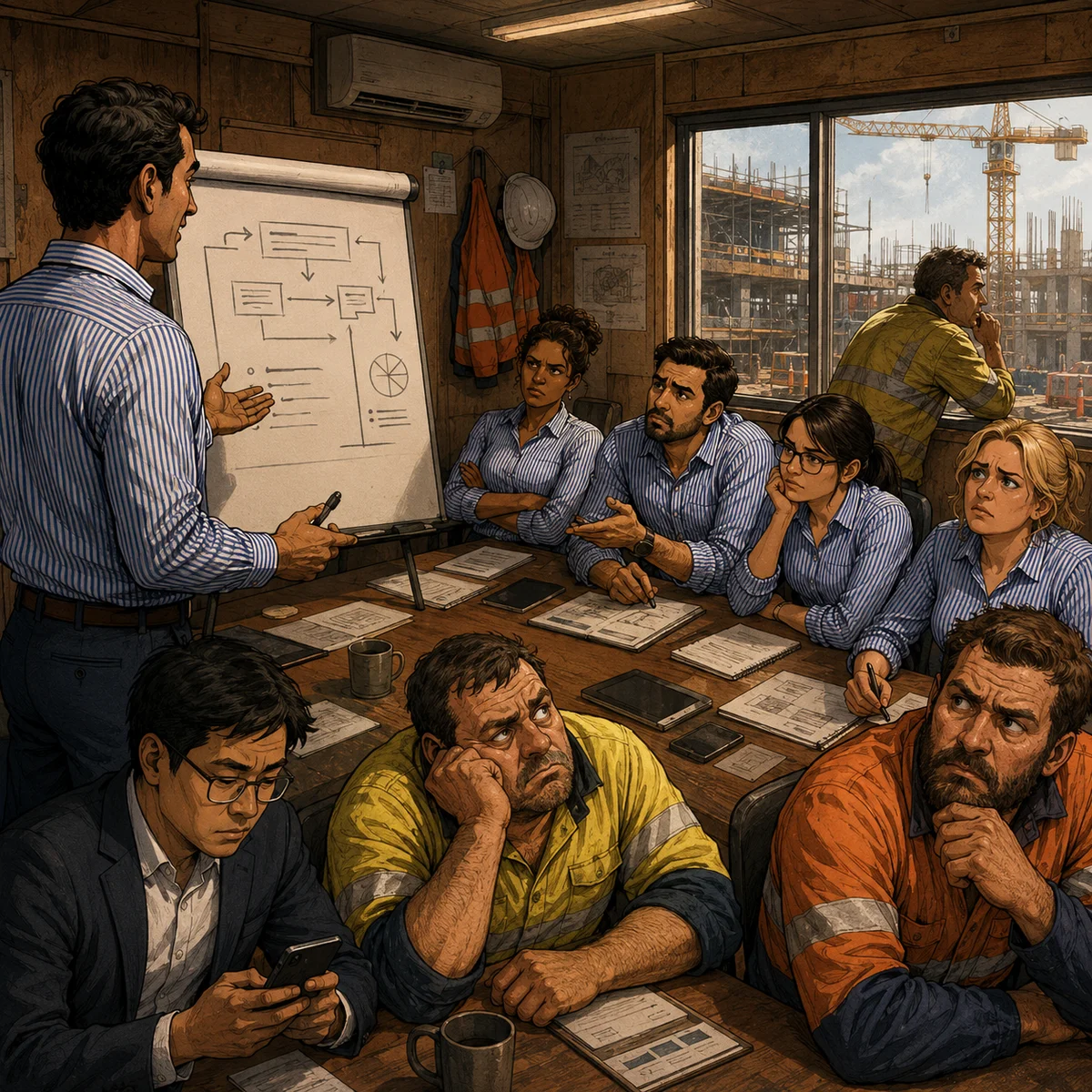
Read the room
Timing, status and emotion determine whether a technically correct message can be heard.
ON SITE
Do not raise a sensitive blame issue in front of a full prestart if a private conversation will get the work fixed faster.
IN THE OFFICE
Choose the room, channel and sequence deliberately. A difficult position may need pre-briefing before formal issue.
IN THE BOARD ROOM
Board politics are part of decision delivery. Know who is defensive, who must not be surprised and who needs a path to support the decision without losing face.

Reap what you sow
Today’s habits become tomorrow’s project conditions.
ON SITE
Good planning, records, housekeeping and interface discipline compound; so do shortcuts and tolerated defects.
IN THE OFFICE
If the team routinely accepts weak scope, poor records or late action, final account will reflect those choices. Commercial outcomes are often delayed consequences.
IN THE BOARD ROOM
Boards eventually receive the culture and controls they incentivised. If only short-term numbers are rewarded, do not be surprised when long-term risk appears.

Red herring
Do not let a vivid side issue distract from the decision that actually changes the outcome.
ON SITE
When a workfront is blocked, separate the real constraint from noisy complaints that do not affect sequence or safety.
IN THE OFFICE
A counterpart may focus discussion on a weak secondary point while the material scope, causation or quantum issue sits elsewhere. Keep returning to the decision.
IN THE BOARD ROOM
Executives should distinguish politically attractive explanations from causal ones. Ask what evidence would change the decision, then focus there.

Right tool for the job
Match the tool to the problem instead of forcing the problem into the tool you know.
ON SITE
Use the plant, crew, method and control that fit the actual constraints. Familiar equipment is not automatically suitable equipment.
IN THE OFFICE
A spreadsheet, contract letter, meeting, call or expert opinion each solves different problems. Choose the channel and instrument that moves the decision.
IN THE BOARD ROOM
Boards should match governance, talent and systems to risk. Enterprise software is not a substitute for judgement, and judgement is not a substitute for basic controls.

Robbing peter to pay paul
Shifting the shortfall does not remove it.
ON SITE
Moving labour, plant or access from one critical area to rescue another may simply create tomorrow’s delay. Make the trade-off explicit.
IN THE OFFICE
Funding one package by delaying another payment, hiding an accrual or borrowing contingency can disguise rather than solve the exposure.
IN THE BOARD ROOM
Boards should recognise when cash, people or risk are merely being transferred between projects or periods. Portfolio control requires seeing the net position.

Running around like a headless chook
Urgency without direction burns capacity.
ON SITE
When the site gets frantic, stop long enough to identify the critical constraint, owner and next decision. More motion can make coordination worse.
IN THE OFFICE
An overloaded commercial team should triage by consequence—cash, rights, approvals, irreversible dates—not by whichever email arrived loudest.
IN THE BOARD ROOM
Leaders create calm by narrowing priorities and authority. Permanent scramble is usually evidence of unclear operating rhythm or chronic understaffing.

Running on fumes
A system can keep moving after resilience has already been spent.
ON SITE
Fatigued crews, thin supervision and repeated overtime may still hit today’s target while increasing tomorrow’s safety and quality risk.
IN THE OFFICE
Commercial teams can hide overload through heroics until reviews, records and judgement start degrading. Watch quality and recovery time, not just output.
IN THE BOARD ROOM
Boards should treat sustained overwork as an operational risk, not a cultural virtue. Capacity failure often appears after the apparent period of success.

Singing from the same hymn sheet
Alignment means the team understands the same position, not that everybody repeats a slogan.
ON SITE
Before a critical interface or client discussion, align site facts, sequence and responsibility so different representatives do not give conflicting stories.
IN THE OFFICE
Agree the factual base, commercial position, authority and speaking roles before external issue. Internal debate is healthy; external contradiction is expensive.
IN THE BOARD ROOM
Boards and JV partners need a coherent authorised position while preserving genuine internal challenge. Alignment should follow decision, not suppress it.

Smoke and mirrors
If the explanation gets more impressive as the evidence gets weaker, start checking.
ON SITE
Complex language, charts or demonstrations cannot replace actual production, quality or compliance. Ask for the observable result.
IN THE OFFICE
A dense model, dashboard or claim narrative may hide basic gaps in assumptions, evidence or cash. Strip it back to facts, movement and decision.
IN THE BOARD ROOM
Executives should be wary of sophisticated presentation used to obscure weak economics. Ask simple questions until the business logic is visible.

Snake in the grass
Some risks stay quiet until the timing favours them.
ON SITE
Watch for unspoken constraints, unresolved defects or stakeholders whose cooperation changes when the work becomes dependent on them.
IN THE OFFICE
A friendly counterparty can still reserve rights, gather evidence and shift position later. Keep records and understand incentives without becoming paranoid.
IN THE BOARD ROOM
Boards should distinguish trust from unmanaged exposure. Relationships matter, but governance exists because incentives can change under pressure.

The squeeze is not worth the juice
Some recoveries cost more to pursue than they are worth.
ON SITE
Do not burn days of supervision or resequencing to save a tiny amount if it creates larger programme or safety risk.
IN THE OFFICE
Price the expected recovery against effort, delay, legal cost, evidence weakness, collectability and relationship. Entitlement is not the same as economic value.
IN THE BOARD ROOM
Executives should allocate scarce attention to material outcomes. A nominal win can still be a poor business decision.

Stop beating around the bush
Get to the decision before the detail exhausts the audience.
ON SITE
If the work cannot proceed, say what is blocking it and what is needed now. Do not make crews decode a ten-minute story.
IN THE OFFICE
Lead with the decision required, recommendation, basis, consequence and remaining risk. Put history behind the point, not in front of it.
IN THE BOARD ROOM
Boards need concise truth. Vagueness often signals either unclear thinking or reluctance to own the recommendation.

Storm in a teacup
Not every flare-up is a project crisis.
ON SITE
Contain the issue, test actual consequence and keep the response proportionate. Site noise can make a minor dispute look bigger than it is.
IN THE OFFICE
Separate emotional heat from contractual and financial materiality. A sharp email does not automatically justify a formal escalation campaign.
IN THE BOARD ROOM
Executives should avoid being drawn into matters that can be resolved at working level. Governance loses value when everything becomes executive.
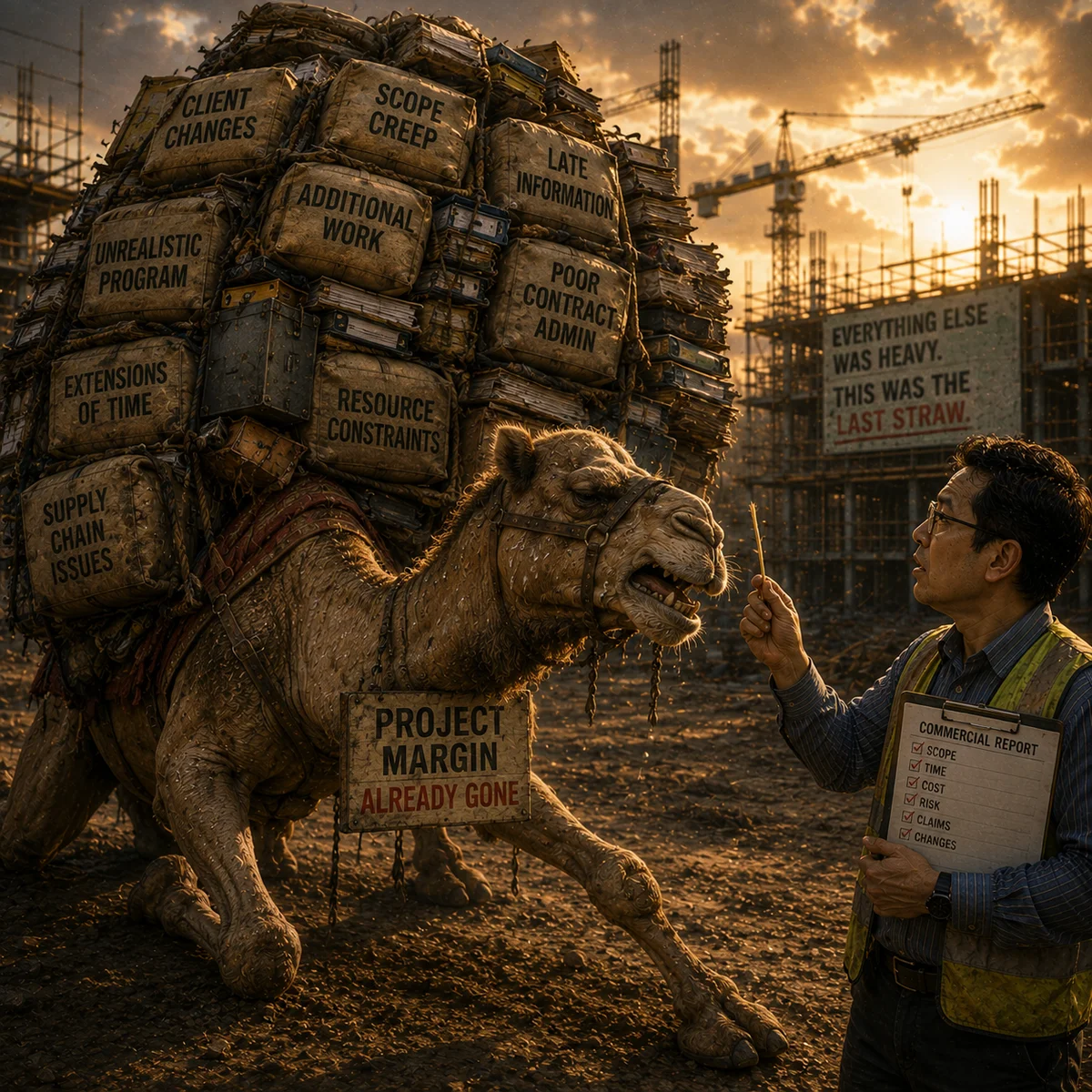
Straw that broke the camels back
The final event is often small; the accumulated load is the real story.
ON SITE
A minor delay or defect can trigger failure after months of overloaded programme, access or supervision. Look behind the last event.
IN THE OFFICE
One small cost or late decision may tip a fragile package because prior exposures were never relieved. Track cumulative load, not only isolated events.
IN THE BOARD ROOM
Boards should not blame the final trigger for a system that was already near failure. Identify the accumulated conditions and capacity limits.

Strike while the iron is hot
Use the window when information, leverage and attention are aligned.
ON SITE
Resolve access, variation or coordination issues while the people and evidence are physically present, before the work moves on.
IN THE OFFICE
Negotiate when the decision-maker is engaged, facts are fresh and both sides have a reason to close. Delay can reduce leverage.
IN THE BOARD ROOM
Executives should recognise temporary strategic windows—market capacity, client appetite, settlement momentum—and act before conditions cool.

Sugar coating it
Softening the tone is fine; softening the fact is dangerous.
ON SITE
Deliver bad news calmly but do not hide that the work is unsafe, late or non-compliant just to avoid conflict.
IN THE OFFICE
Use neutral language, but state the movement, exposure and decision plainly. False reassurance wastes the remaining response time.
IN THE BOARD ROOM
Executives need controlled bad news, not comforting distortion. Trust rises when adverse information arrives early with a credible recovery path.
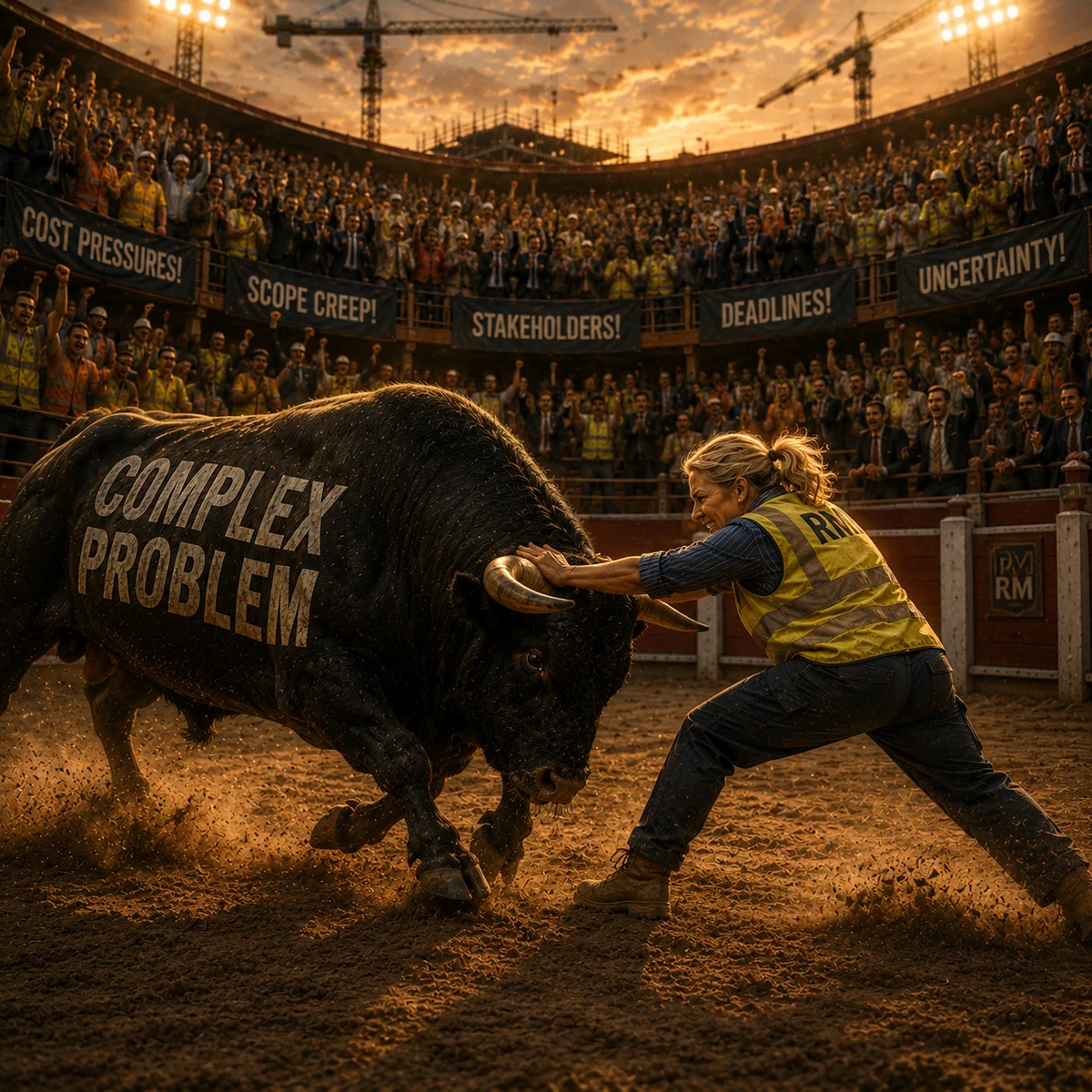
Take the bull by the horns
Some problems improve only when somebody owns the difficult conversation or decision.
ON SITE
If a recurring interface, defect or performance issue is blocking work, stop circling it and bring the right people together with facts and an action.
IN THE OFFICE
Own the hard package, overdue negotiation or unresolved approval. Escalate with a recommendation rather than forwarding the discomfort upward.
IN THE BOARD ROOM
Boards value leaders who confront material issues before they become forced choices. Courage is useful when attached to evidence and authority.
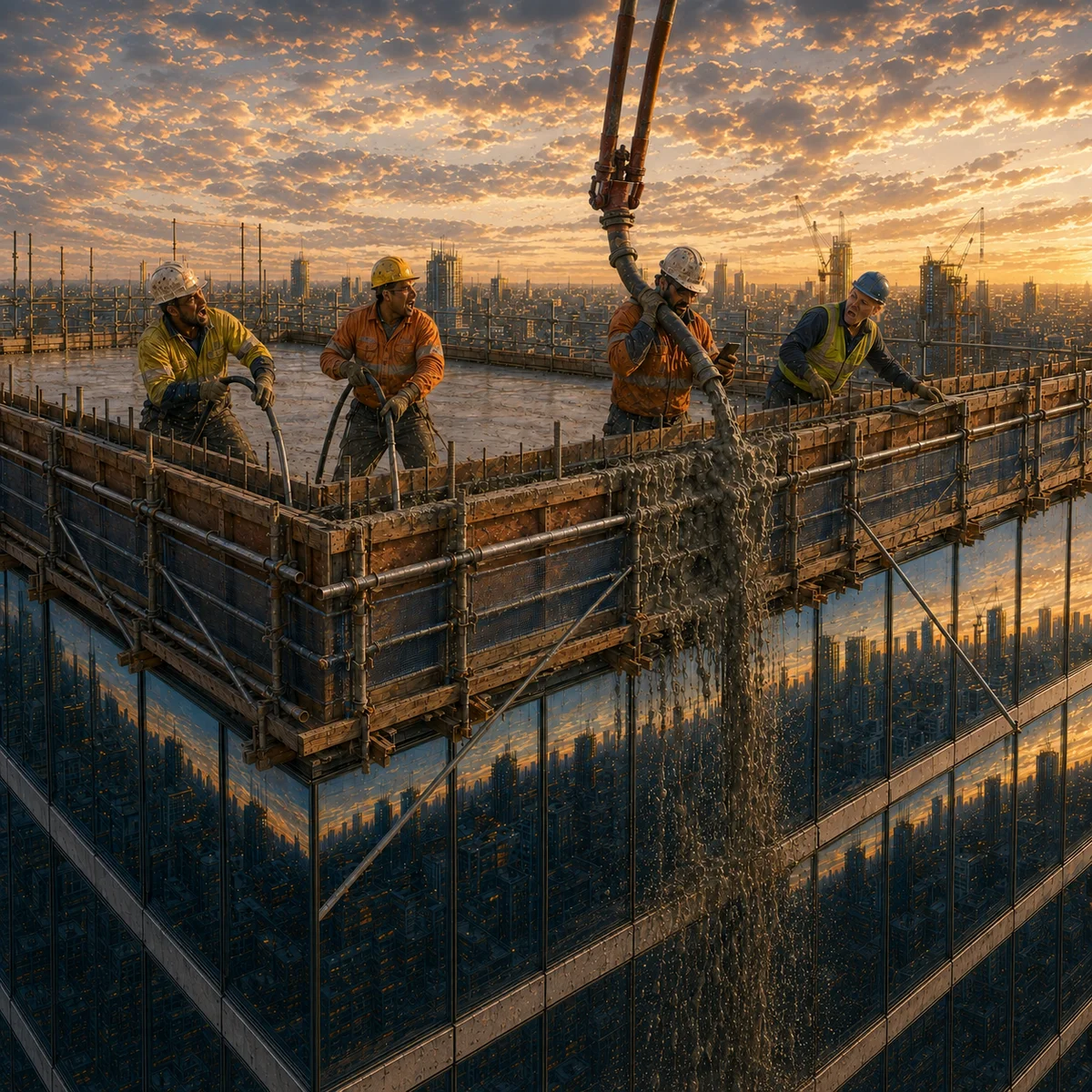
Taking your eye off the ball
Control can disappear quickly when attention moves away from the critical few things.
ON SITE
A workfront that was stable last week can slip through safety, quality or access if supervision assumes it will stay stable.
IN THE OFFICE
Do not let a major claim or monthly report distract from basic notices, payments, commitments and forecast movements on the live packages.
IN THE BOARD ROOM
Boards should watch whether strategic distractions are eroding core delivery. New opportunities do not excuse losing grip on existing obligations.

That ship has sailed
Some decisions become irreversible once time, work or external commitment has moved on.
ON SITE
Once the work is built, access is gone or mobilisation has passed, the practical options are different. Stop planning as though the old window remains open.
IN THE OFFICE
A missed contractual date, executed deed or settled position may close certain paths. Focus on what remains available rather than arguing with chronology.
IN THE BOARD ROOM
Boards should recognise when reversal costs exceed value. Good leadership reallocates attention to the best remaining option.
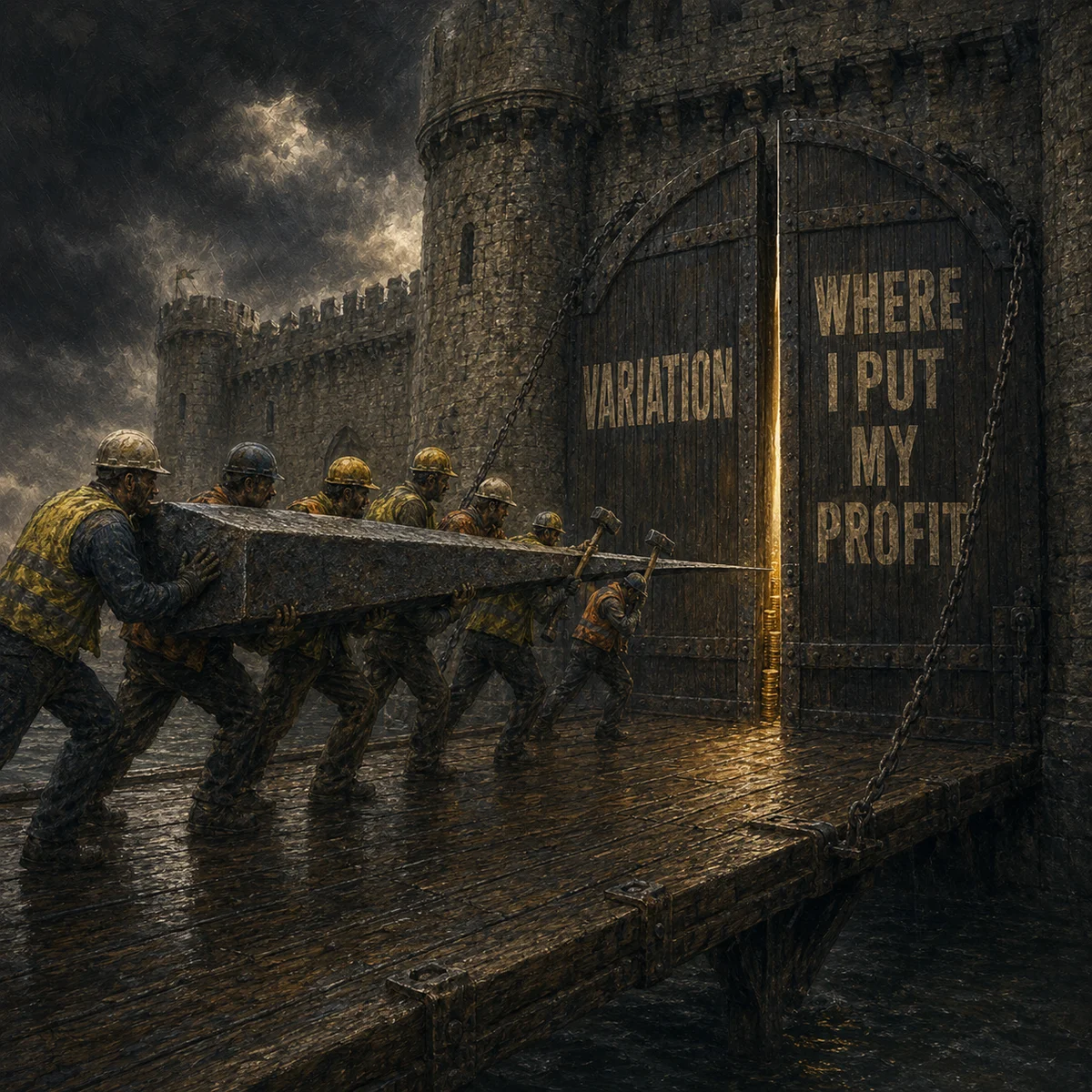
Thin edge of the wedge
Small exceptions can create a pathway for much larger expectations.
ON SITE
A temporary workaround, tolerance or access concession should be labelled and controlled so it does not quietly become the new site standard.
IN THE OFFICE
One unqualified concession can become precedent across later variations or packages. State scope, limits and reservation when the exception matters.
IN THE BOARD ROOM
Boards should consider second-order precedent before making a convenient local exception. What is harmless once may be expensive when repeated.

Throwing a spanner in the works
One unmanaged interface can disrupt a much larger system.
ON SITE
A late design change, unavailable crane or conflicting workfront can stall multiple crews. Identify dependencies before the disruption arrives.
IN THE OFFICE
A new approval condition, late qualification or missing input can stop an otherwise ready commercial process. Surface interface risks early.
IN THE BOARD ROOM
Boards should ask what single dependency could interrupt the strategy. Complex systems often fail at interfaces, not at their strongest components.

Thrown under the bus
If accountability only appears after failure, trust will disappear before performance improves.
ON SITE
Do not protect yourself by rewriting site history around the person with the least status. Establish facts, decisions and shared conditions.
IN THE OFFICE
Keep contemporaneous records and clarify authority so responsibility is not invented retrospectively. Own your part before allocating somebody else’s.
IN THE BOARD ROOM
Leaders who routinely sacrifice juniors create defensive organisations that hide risk. Accountability must be fair enough that people still raise bad news.

Time is money
Delay has a commercial value even when nobody invoices it today.
ON SITE
Idle crews, plant, access clashes and slow decisions consume real cost and programme float. Treat waiting as an exposure, not empty space.
IN THE OFFICE
Approval cycles, late information and unresolved claims tie up cash and management time. Put dates and owners on decisions.
IN THE BOARD ROOM
Boards should price time through working capital, overhead, opportunity cost and strategic delay—not just liquidated damages.

Tip of the iceberg
The visible problem may be only the part that has surfaced.
ON SITE
One defect, delay or safety event can indicate a wider control failure. Sample beyond the first instance before declaring it isolated.
IN THE OFFICE
A small forecast movement or disputed item may point to broader scope, evidence or counterparty problems. Test the surrounding population.
IN THE BOARD ROOM
Executives should ask whether the event is local or systemic. The wrong assumption either wastes resources or leaves enterprise risk hidden.

Trying to squeeze blood out of a stone
You cannot recover value that the counterparty or asset does not have.
ON SITE
Demanding impossible production from exhausted resources or incapable supply will not create capacity. Change the constraint or the plan.
IN THE OFFICE
A strong entitlement against an insolvent or cash-starved counterparty may still be worth little. Consider collectability alongside legal position.
IN THE BOARD ROOM
Boards should distinguish theoretical receivables from economic recovery. Counterparty quality and liquidity matter to value.
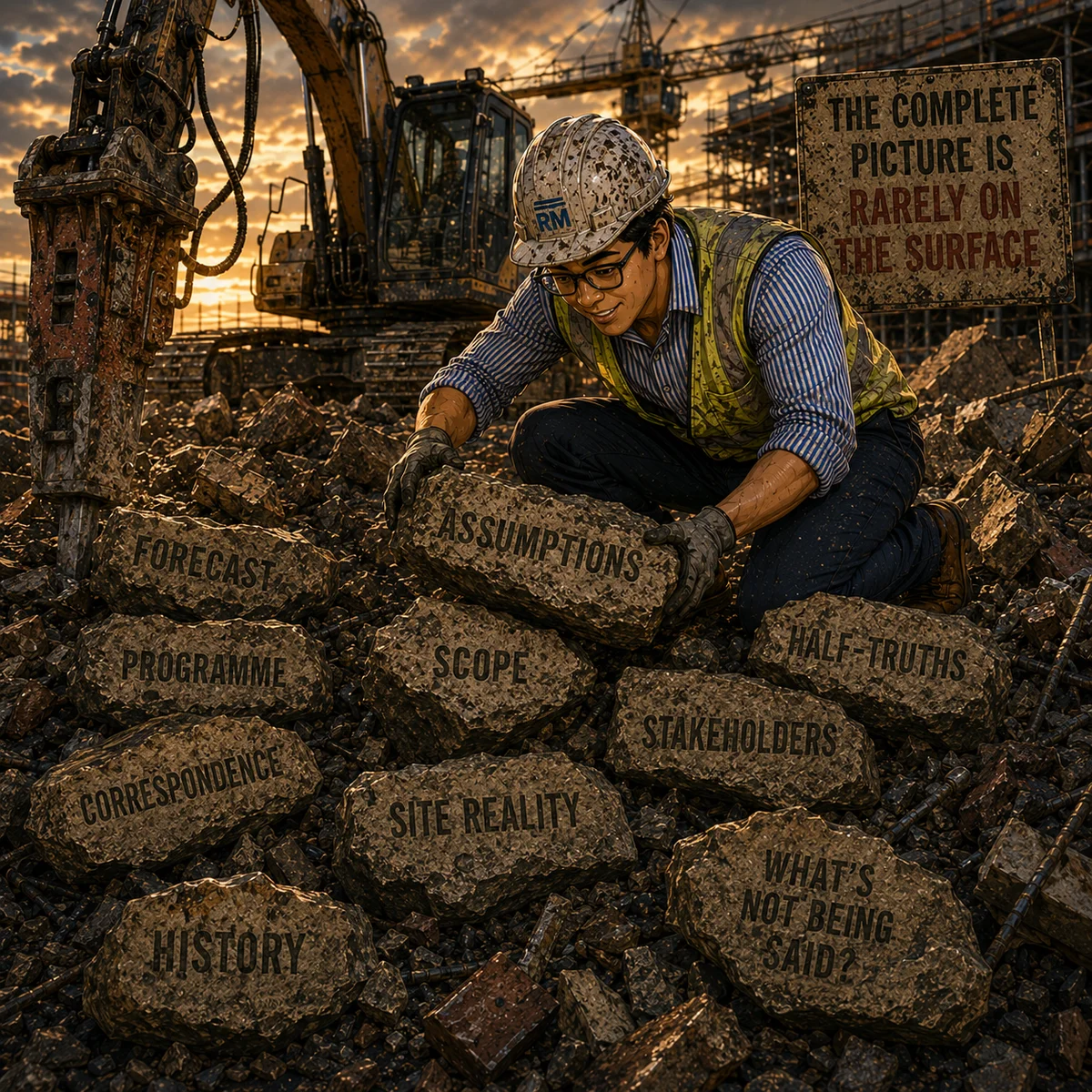
Turn over every rock
When the consequence is material, do not stop at the first plausible explanation.
ON SITE
For recurring defects, delay or productivity problems, inspect the interfaces and evidence until the real constraint is identified.
IN THE OFFICE
On a material claim, recovery or forecast issue, test documents, chronology, cost, authority and counterpart position rather than relying on one convenient record.
IN THE BOARD ROOM
Executives should demand depth proportionate to consequence. Exhaustive investigation is expensive, so reserve it for decisions where hidden facts could change the outcome.

Turnover is vanity profit is sanity cash is reality
Revenue looks impressive; profit explains value; cash tells you whether the business can keep breathing.
ON SITE
High site production is useful only if the work is compliant, measurable and recoverable. Activity without conversion can deepen exposure.
IN THE OFFICE
Track earned value, margin, cash timing, accruals and collectability separately. A profitable forecast can still produce painful working capital.
IN THE BOARD ROOM
Boards should interrogate the bridge from revenue to margin to cash. Growth that consumes uncontrolled cash can weaken the business while looking successful.

Tying loose ends
Closeout is a process, not the week before everyone demobilises.
ON SITE
Finish defects, as-builts, warranties, testing and handover records while the people and access still exist.
IN THE OFFICE
Reconcile final accounts, notices, securities, evidence, claims and residual risks before knowledge walks off the project.
IN THE BOARD ROOM
Boards should treat completion as preservation of value. Poor closeout converts earned margin into lingering obligations and expensive corporate memory work.

Up the creek without a paddle
The worst time to discover you have no contingency is after the primary plan fails.
ON SITE
Critical activities need recovery options for access, plant, labour, weather and design. Know what you will do if the first path closes.
IN THE OFFICE
Protect alternative suppliers, notice rights, evidence, authority and cash options before urgency removes them.
IN THE BOARD ROOM
Boards should identify situations where the enterprise has no credible fallback. Contingency is strategic freedom, not pessimism.

What gets measured gets managed
Measurement focuses attention—so choose measures that reflect the outcome you actually want.
ON SITE
Track safety, quality, production and constraints in ways that drive useful action, not just attractive numbers. Watch for crews gaming a target.
IN THE OFFICE
Measure forecast movement, cash, ageing, claims, closeout and action ownership, but audit the reality behind the metric.
IN THE BOARD ROOM
Boards should expect metrics to influence behaviour. Pair targets with independent checks so the organisation does not optimise the score while damaging the system.

Wheels have fallen off
Once several controls fail together, stop pretending normal management will recover the situation.
ON SITE
If programme, quality, labour and coordination are all deteriorating, declare recovery mode and rebuild the workfront around a current-state plan.
IN THE OFFICE
A package with broken records, forecast, payment, claims and stakeholder trust needs a structured recovery snapshot, not another normal monthly review.
IN THE BOARD ROOM
Boards should recognise when incremental correction is no longer enough. Change governance, resources or strategy explicitly and measure whether control returns.

When all you have is a hammer all you see are nails
Expertise becomes a blind spot when every problem is forced into the same solution.
ON SITE
Do not solve every site issue with more labour, more plant or another meeting. Identify the actual constraint first.
IN THE OFFICE
Not every dispute needs a letter, every risk a spreadsheet or every negotiation a contractual threat. Match the response to the problem.
IN THE BOARD ROOM
Boards should challenge dominant functional lenses. Legal, commercial, delivery and finance each see part of the system; strategy needs the combined view.
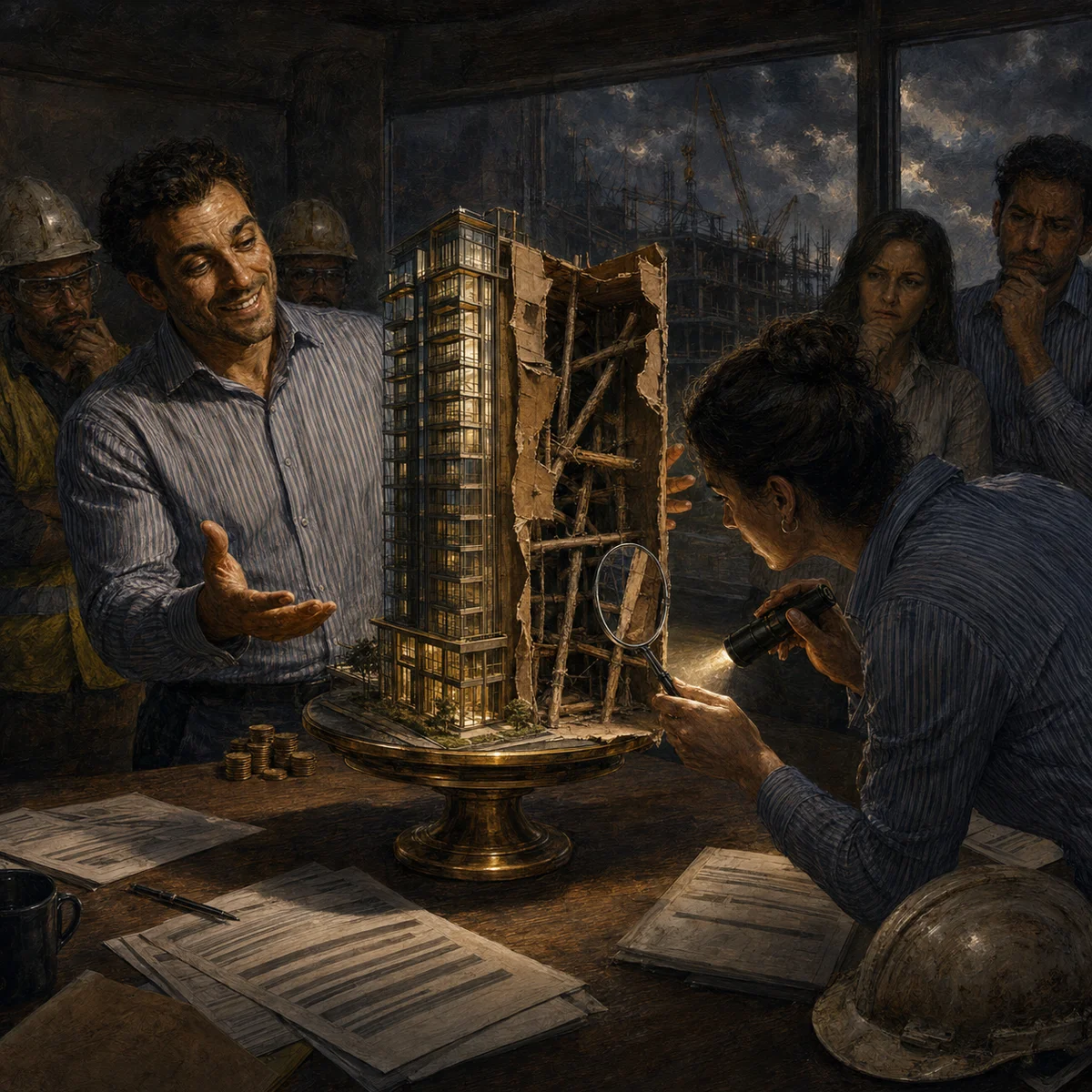
When it sounds too good to be true
Exceptional upside deserves exceptional checking.
ON SITE
A supplier promising impossible lead time, output or price may be hiding assumptions you will inherit later. Verify capacity and prerequisites.
IN THE OFFICE
Unusually cheap bids, effortless recoveries and guaranteed approvals deserve deeper review of exclusions, evidence and incentives.
IN THE BOARD ROOM
Boards should apply scepticism to deals that offer high return with no visible trade-off. Ask where the risk went, because it rarely vanished.

When the left hand does not speak to the right hand
Internal interface failure can make good people produce a bad project outcome.
ON SITE
Design, delivery, quality and commercial teams need shared facts and clear handoffs. One group changing course without the others creates rework.
IN THE OFFICE
Align procurement, planning, finance, legal and package teams around the same current position before external issue.
IN THE BOARD ROOM
Boards should examine cross-functional incentives and governance when projects receive conflicting instructions. Coordination is an enterprise capability.

When the walls have ears
Treat sensitive information as though it may travel beyond the room.
ON SITE
Site sheds, lifts and informal areas are not reliable confidential spaces. Discuss sensitive people, claim or incident matters deliberately.
IN THE OFFICE
Control recipients, channels and records for privileged, personal or commercially sensitive information. Copying more people is not automatically safer.
IN THE BOARD ROOM
Boards should assume consequential information can leak. Use disciplined pathways, need-to-know access and messages that remain defensible if repeated.
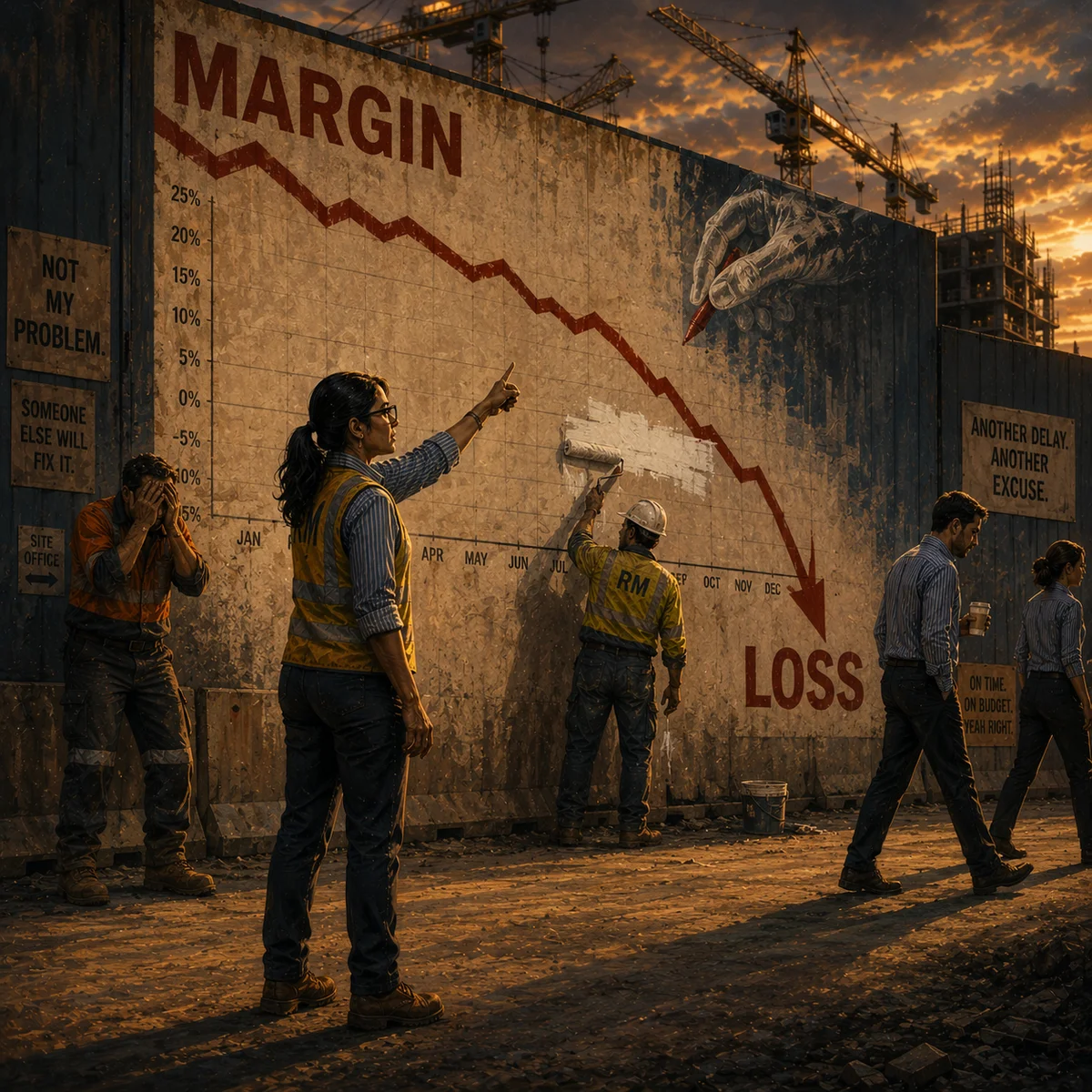
The writing is on the wall
Repeated signals deserve action before formal failure confirms them.
ON SITE
Falling productivity, absenteeism, rework and supplier excuses can show a workfront is deteriorating before the programme admits it.
IN THE OFFICE
Slow responses, unpaid downstream parties, changing personnel or repeated forecast misses can signal counterparty distress. Verify and protect options early.
IN THE BOARD ROOM
Boards should act on converging indicators rather than wait for certainty. By the time failure is undeniable, leverage is usually lower.

You are only as strong as your weakest link
The whole outcome inherits the risk of the critical component that cannot perform.
ON SITE
A project can have strong crews and still fail because one interface, supplier, design package or access point controls the sequence.
IN THE OFFICE
A strong commercial position can be undermined by one missing notice, unsupported assumption, weak quantum or insolvent counterparty.
IN THE BOARD ROOM
Boards should identify critical dependencies across people, systems, projects and counterparties. Strengthen the weak link or build redundancy around it.

You broke it, you bought it
Actions have ownership consequences—especially when you change something you did not fully understand.
ON SITE
If your team damages, modifies or disrupts an existing condition, expect to own the recovery unless responsibility was properly agreed otherwise.
IN THE OFFICE
A unilateral commercial change, unauthorised commitment or careless instruction can create obligations the business then has to manage. Know your authority before altering the position.
IN THE BOARD ROOM
Boards should make decision ownership explicit. People take better care with irreversible choices when consequence cannot simply be pushed elsewhere.

You can’t unscramble an omelette
Some decisions create consequences you cannot neatly reverse.
ON SITE
Demolition, irreversible installation, access closure and major resequencing deserve extra checking because restoration is costly or impossible.
IN THE OFFICE
Once a deed is signed, a position issued or a right allowed to expire, later analysis may not restore the original option. Check one-way decisions properly.
IN THE BOARD ROOM
Boards should spend decision time according to reversibility. Move fast on reversible experiments and slow down where capital, reputation or legal position locks in.

You made your bed now lie in it
Own the consequence of your decision before asking others to absorb it.
ON SITE
If your team chose the sequence, method or access arrangement, do not rewrite history when the downside arrives. Fix it and learn from it.
IN THE OFFICE
Commercial professionals should acknowledge their own assumptions, approvals and missed actions when recovering a package. Accountability improves credibility.
IN THE BOARD ROOM
Boards should avoid retrospective blame after an authorised risk is taken and crystallises. Review the decision quality, then manage the consequence.

You scratch my back ill scratch yours
Reciprocity is normal; hidden quid pro quo is dangerous.
ON SITE
Teams work better when practical cooperation is returned, but safety, quality and contractual controls should not be traded as personal favours.
IN THE OFFICE
Relationships often run on reciprocal help. Keep exchanges professional, transparent and within authority so goodwill does not become obligation or conflict.
IN THE BOARD ROOM
Boards should understand relational capital while maintaining governance around conflicts, gifts and preferential treatment. Cooperation is valuable; compromised independence is not.
You’re barking up the wrong tree
A lot of effort can be wasted solving the wrong problem or chasing the wrong owner.
ON SITE
If the constraint is design, access or upstream approval, pushing the crew harder will not fix it. Trace the cause and decision owner.
IN THE OFFICE
Do not keep writing to a person who cannot approve, pursuing a claim against the wrong basis or interrogating cost when causation is the real gap.
IN THE BOARD ROOM
Boards should redirect resources when evidence shows the assumed cause or stakeholder is wrong. Persistence is not virtue when the target is incorrect.

You’re only as good as your last job
Reputation has a short memory when the next result goes bad.
ON SITE
Yesterday’s pour, lift or milestone does not excuse today’s sloppy setup. Finish cleanly, hand over properly and treat the next task as the one people will remember.
IN THE OFFICE
A strong package history buys trust, not immunity. Keep forecasts, notices, assessments and records current because one avoidable miss can reset how much checking your work attracts.
IN THE BOARD ROOM
Boards remember patterns but react to the latest surprise. Protect credibility by making reliable delivery repeatable rather than leaning on an old flagship win.
